Table of Contents
- What Are MLOps Pipelines
- Why MLOps Pipelines Matter for Businesses in 2026
- How to Build Production-Ready MLOps Pipelines: Step-by-Step
- Best Practices for Production MLOps Pipeline Design
- How AI Is Changing MLOps Pipelines in 2026
- Tools and Resources for Building MLOps Pipelines
- Implementing MLOps Pipelines for Sustainable Model Delivery
- Frequently Asked Questions
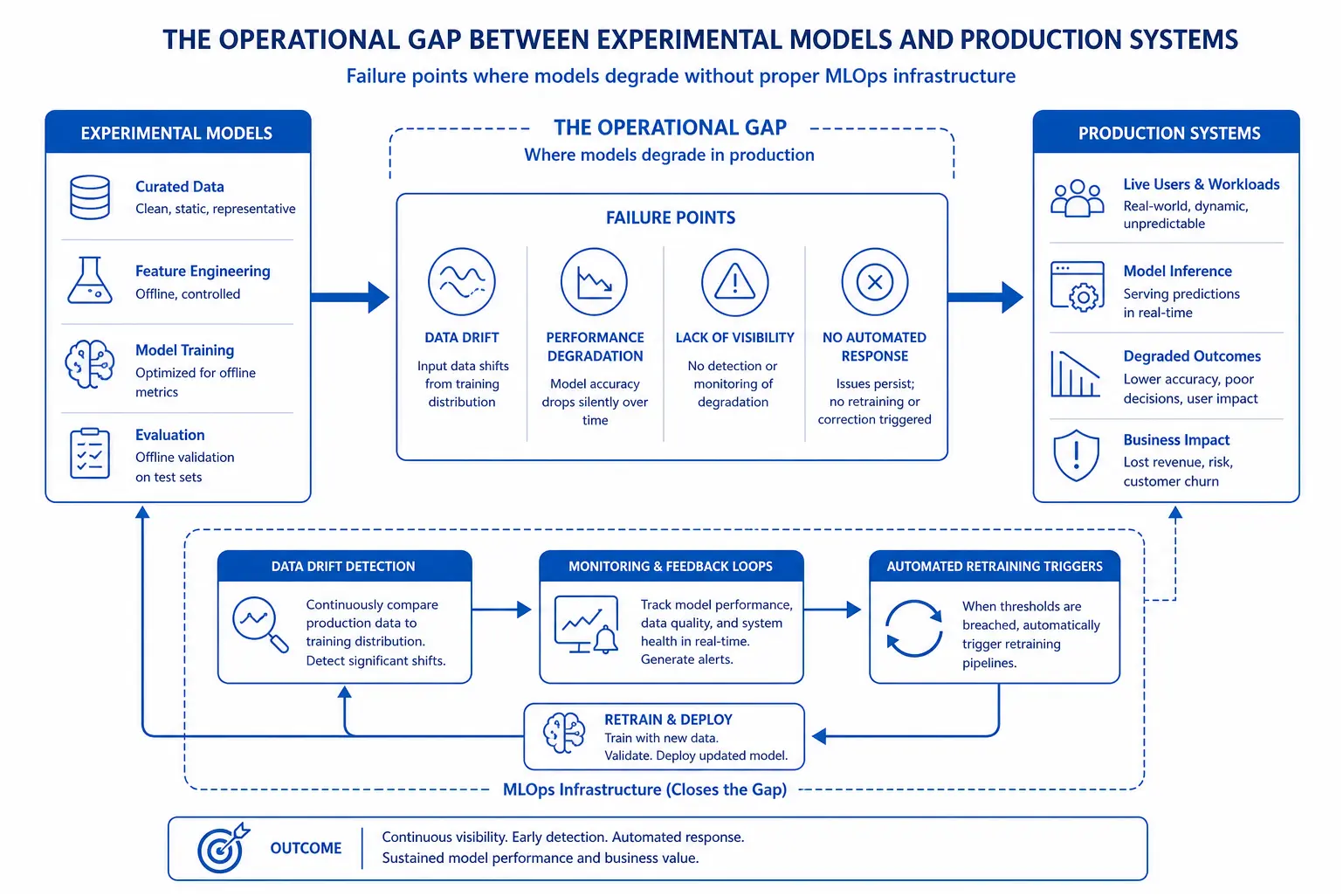
Over 87% of machine learning models never make it to production, and those that do often fail within months due to data drift, monitoring gaps, or deployment bottlenecks. The gap between training a model in a notebook and running it reliably at scale represents one of the most expensive challenges in enterprise AI. Companies invest millions in data science talent only to watch models languish in development environments, unable to deliver business value.
The core problem is not the models themselves—it’s the absence of production-grade MLOps pipelines that automate the entire lifecycle from data ingestion through deployment, monitoring, and retraining. Without proper infrastructure, even the most sophisticated algorithms become technical debt. Teams at H-in-Q.com have architected MLOps systems that reduce deployment time from months to days while maintaining model performance in dynamic production environments.
In this guide, you’ll discover how to build production-ready MLOps pipelines with proven architecture patterns, automation frameworks, and continuous delivery strategies that keep models performing reliably in 2026 and beyond.
What Are MLOps Pipelines
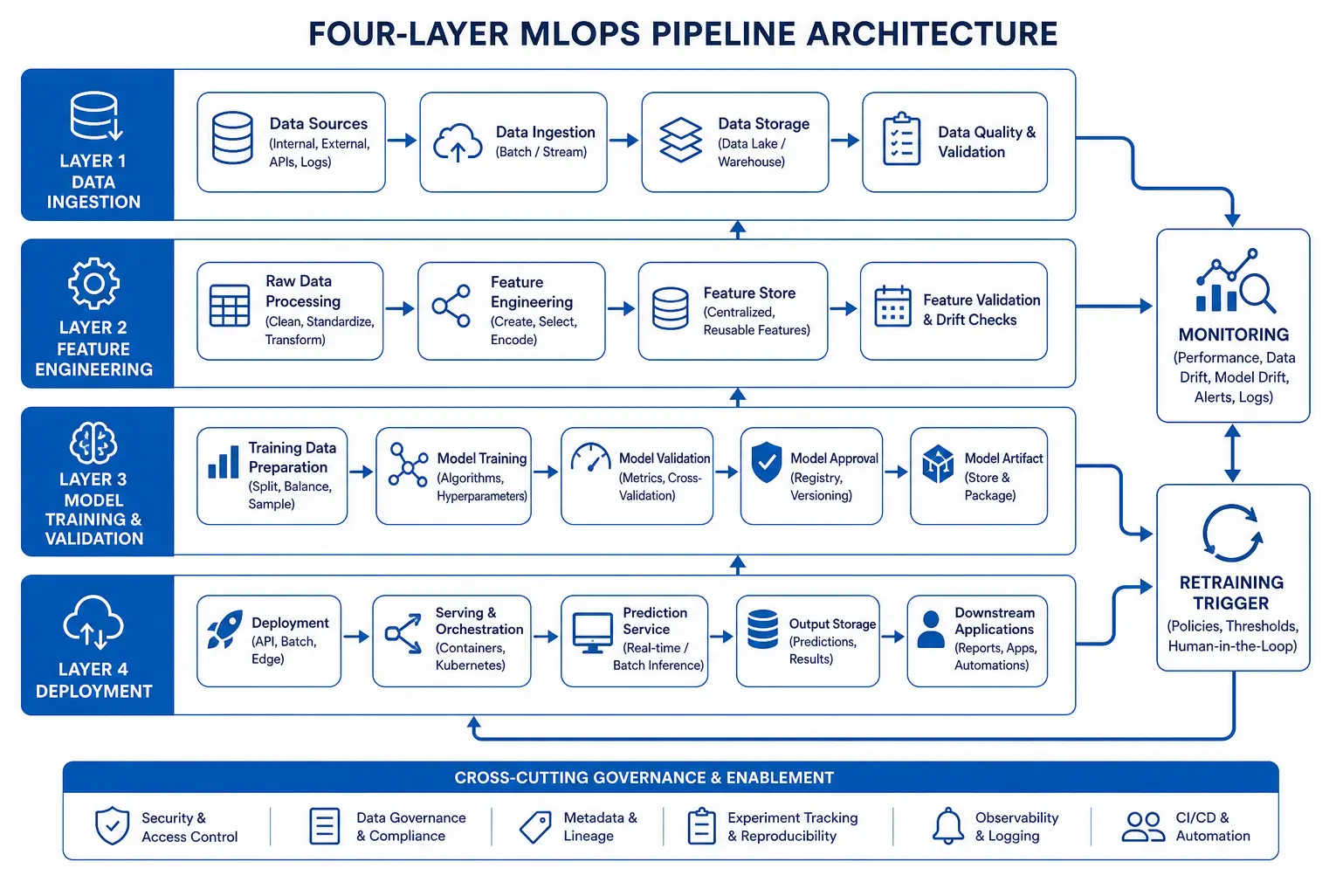
MLOps pipelines are automated workflows that orchestrate the complete machine learning lifecycle—from data ingestion and feature engineering through model training, validation, deployment, monitoring, and retraining—enabling continuous delivery of ML models to production environments with reliability and reproducibility.
Unlike traditional software deployment pipelines, MLOps pipelines manage three distinct artifacts: code, data, and models. Each artifact requires versioning, testing, and deployment strategies. The pipeline must handle data validation to catch schema changes, feature engineering that transforms raw data into model inputs, experiment tracking to compare model versions, and deployment automation that routes predictions to applications.
The architecture mirrors DevOps CI/CD principles but adds complexity inherent to machine learning. Data drift requires continuous monitoring and automated retraining triggers. Model performance degrades silently without proper observability. Feature stores must serve both training and inference with consistency guarantees. These requirements demand purpose-built tooling beyond standard DevOps platforms.
Production MLOps pipelines integrate multiple specialized systems: orchestration engines like Kubeflow or Airflow, experiment tracking platforms like MLflow or Weights & Biases, feature stores like Feast or Tecton, model registries, and monitoring solutions. The pipeline coordinates these components to maintain model quality while accelerating iteration cycles.
Why MLOps Pipelines Matter for Businesses in 2026
Gartner research shows that organizations with mature MLOps practices deploy models 5x faster and achieve 3x higher model accuracy in production compared to teams relying on manual processes. The business impact extends beyond deployment velocity—companies with automated pipelines reduce the cost per prediction by 40-60% through efficient resource utilization and reduced engineering overhead.
The stakes have escalated dramatically. Regulatory frameworks like the EU AI Act and emerging model governance requirements demand audit trails, reproducibility, and explainability. Manual tracking cannot meet these compliance burdens at scale. Automated pipelines create the documentation, versioning, and lineage tracking that regulators require.
Model performance degradation represents a hidden tax on revenue. A recommendation engine that degrades from 85% to 78% accuracy costs an e-commerce platform millions in lost conversions. Without automated monitoring and retraining, this degradation goes undetected until business metrics decline. MLOps pipelines transform model maintenance from reactive firefighting to proactive optimization.
Competitive pressure compounds the urgency. Companies that iterate models weekly outmaneuver competitors stuck in quarterly release cycles. Financial services firms retrain fraud detection models daily to adapt to evolving attack patterns. Retailers adjust pricing models hourly based on inventory and demand signals. This operational tempo requires automation—human-in-the-loop processes cannot keep pace.
The talent shortage in data science makes efficiency critical. Teams spend 60-80% of their time on deployment plumbing rather than model improvement. Automated pipelines reclaim this time, allowing data scientists to focus on feature engineering and algorithm selection rather than infrastructure management.
How to Build Production-Ready MLOps Pipelines: Step-by-Step
1. Define pipeline requirements and success metrics. Start by documenting deployment frequency targets, acceptable prediction latency, model accuracy thresholds, and retraining triggers. Specify compliance requirements like data retention policies or audit logging. Map dependencies between data sources, features, and models. These requirements drive architecture decisions and tool selection.
2. Establish data ingestion and validation infrastructure. Build automated data pipelines that ingest from source systems, validate schemas, check data quality, and version datasets. Implement data profiling to detect distribution shifts early. Use tools like Great Expectations or TensorFlow Data Validation to codify data contracts. Store validated datasets in versioned repositories with lineage tracking to training runs.
3. Implement feature engineering and feature store architecture. Separate feature computation from model code to enable reuse across models and consistency between training and serving. Deploy a feature store that handles both batch and real-time feature computation. Define feature schemas, implement backfill processes for historical features, and establish serving APIs for inference. Tools like Feast or Tecton provide open-source and managed options.
4. Set up experiment tracking and model registry systems. Deploy platforms that log hyperparameters, metrics, artifacts, and code versions for every training run. Implement comparison tools that surface the best-performing models based on validation metrics. Establish a model registry that stores trained models with metadata, lineage, and deployment status. MLflow, Weights & Biases, or Neptune.ai provide these capabilities with different trade-offs in complexity and cost.
5. Build automated training orchestration workflows. Create pipelines that trigger training jobs on schedule or data availability, allocate compute resources, execute training scripts, log experiments, and register successful models. Use orchestration engines like Kubeflow Pipelines, Apache Airflow, or Prefect to manage dependencies and retries. Implement resource scaling to optimize cost—spin up GPU instances for training, shut down when complete.
6. Deploy continuous integration and testing for models. Establish automated testing that validates model performance on holdout datasets, checks for bias in predictions across demographic groups, verifies inference latency under load, and ensures backward compatibility with serving infrastructure. Integrate these tests into CI pipelines that run before promoting models to production. Fail deployments that don’t meet quality gates.
7. Implement model deployment automation with rollback capabilities. Build deployment pipelines that package models with dependencies, deploy to serving infrastructure, route traffic gradually through canary or blue-green deployments, and monitor performance metrics. Implement automated rollback triggers when error rates or latency exceed thresholds. Use container orchestration platforms like Kubernetes with model serving frameworks like TensorFlow Serving, TorchServe, or Seldon Core.
8. Establish comprehensive monitoring and alerting systems. Deploy monitoring that tracks prediction volume, latency, error rates, input data distributions, model accuracy on labeled production data, and infrastructure health. Set up alerts for anomalies in any metric. Implement dashboards that surface model performance trends. Tools like Prometheus, Grafana, and specialized ML monitoring platforms like Arize or Fiddler provide these capabilities.
9. Configure automated retraining triggers and workflows. Define conditions that trigger model retraining—scheduled intervals, performance degradation below thresholds, or significant data drift. Build workflows that fetch fresh training data, retrain models with updated hyperparameters, validate performance, and deploy if improvements are validated. Implement human approval gates for high-stakes models before automated deployment.
10. Document architecture and establish operational runbooks. Create documentation that explains pipeline components, data flows, deployment processes, and troubleshooting procedures. Build runbooks for common incidents like model performance degradation, data pipeline failures, or serving infrastructure outages. Train team members on operational procedures to ensure 24/7 coverage capability.
Best Practices for Production MLOps Pipeline Design
1. Version everything—data, code, features, and models together. Treat reproducibility as a first-class requirement. Every training run should reference specific versions of datasets, feature definitions, training code, and hyperparameters. This enables debugging production issues, regulatory compliance, and A/B testing of model versions. Use tools like DVC for data versioning alongside Git for code.
2. Separate training and serving infrastructure completely. Training requires burst compute with GPUs and high memory. Serving demands low latency, high availability, and cost efficiency. Optimize each independently. Use spot instances or preemptible VMs for training. Deploy serving infrastructure with autoscaling, load balancing, and geographic distribution. Never share resources between training and inference workloads.
3. Implement feature computation consistency between training and serving. Feature engineering code must produce identical outputs whether computing features for historical training data or real-time inference. Use the same codebase and execution environment for both. Feature stores solve this by centralizing computation. Inconsistent features between training and serving cause silent model degradation that’s difficult to diagnose.
4. Start with simple pipelines and add complexity only when necessary. Begin with scheduled batch retraining and basic monitoring. Add real-time features, online learning, or complex orchestration only when business requirements justify the operational overhead. Premature optimization creates maintenance burden without corresponding value. Many successful production systems run on surprisingly simple architectures.
5. Build observability into every pipeline component from day one. Instrument data pipelines to track record counts, processing times, and validation failures. Log model training metrics, hyperparameters, and resource utilization. Monitor serving infrastructure for latency, throughput, and error rates. Observability is not optional—it’s the foundation for debugging, optimization, and reliability. You cannot improve what you cannot measure.
6. Implement gradual rollouts with automated rollback for all deployments. Never deploy models directly to 100% of traffic. Use canary deployments that route 5-10% of traffic to new models while monitoring performance. Expand gradually if metrics remain healthy. Configure automated rollback if error rates spike or latency degrades. This pattern prevents widespread outages from model regressions.
7. Design for failure with circuit breakers and fallback models. Production systems fail—data pipelines break, models timeout, serving infrastructure crashes. Implement circuit breakers that detect failures and route traffic to fallback models or rule-based systems. Maintain simple backup models that provide acceptable performance when primary models fail. Graceful degradation beats complete service outages.
8. Establish data quality gates that fail pipelines on validation errors. Bad training data produces bad models. Implement automated checks for schema changes, missing values, outliers, and distribution shifts. Fail training pipelines when data quality checks don’t pass. Alert data engineering teams to investigate. This prevents models trained on corrupted data from reaching production.
How AI Is Changing MLOps Pipelines in 2026
Large language models and generative AI are transforming MLOps pipeline design in fundamental ways. LLM-powered code generation tools now write data validation scripts, feature engineering functions, and deployment configurations from natural language specifications. Data scientists describe requirements in plain English; AI assistants generate pipeline code, reducing implementation time by 40-60%.
AI-driven hyperparameter optimization has evolved beyond grid search and Bayesian methods. Neural architecture search algorithms now design entire model architectures, feature engineering pipelines, and training strategies automatically. AutoML platforms integrated into MLOps pipelines continuously experiment with architectural variations, selecting optimal configurations without manual intervention.
Anomaly detection powered by foundation models identifies subtle data drift and model degradation patterns that rule-based systems miss. These AI monitoring systems learn normal operating patterns and flag deviations requiring investigation. They reduce false positive alerts by 70% compared to threshold-based monitoring, focusing engineering attention on genuine issues.
Natural language interfaces to MLOps platforms democratize access beyond data science teams. Product managers query model performance, business analysts trigger retraining workflows, and executives review deployment metrics through conversational interfaces. This accessibility accelerates decision-making and reduces bottlenecks from specialized tooling knowledge.
Organizations working with H-in-Q.com integrate AI-powered pipeline optimization that continuously analyzes deployment patterns, resource utilization, and model performance to recommend architecture improvements. These systems identify cost optimization opportunities, predict capacity requirements, and suggest feature engineering strategies based on production data patterns.
The most significant shift is AI systems that write, test, and deploy models autonomously within governance guardrails. Human data scientists define objectives, constraints, and approval thresholds. AI agents handle experimentation, validation, and deployment. This human-AI collaboration pattern will define the next generation of MLOps infrastructure.
Tools and Resources for Building MLOps Pipelines
Kubeflow provides a complete MLOps platform built on Kubernetes, offering pipeline orchestration, experiment tracking, and multi-framework model serving. Best suited for teams with Kubernetes expertise and complex multi-step workflows. Open-source with strong community support and enterprise backing from Google.
MLflow delivers lightweight experiment tracking, model registry, and deployment tools with minimal infrastructure requirements. Ideal for small to medium teams starting their MLOps journey. Integrates easily with existing workflows and supports all major ML frameworks. Open-source with managed offerings from Databricks.
Vertex AI offers Google Cloud’s fully managed MLOps platform with AutoML, custom training, feature store, and deployment services. Reduces operational overhead for teams willing to commit to Google Cloud. Provides tight integration with BigQuery and other GCP services. Pricing based on compute and storage usage.
Amazon SageMaker provides AWS’s comprehensive ML platform covering the entire lifecycle from data labeling through deployment and monitoring. Strong integration with AWS services and extensive pre-built algorithms. Best for organizations already invested in AWS infrastructure. Pay-per-use pricing model.
Feast serves as an open-source feature store that manages feature computation, storage, and serving for both training and inference. Supports batch and real-time features with pluggable backends. Reduces feature engineering complexity and ensures training-serving consistency. Requires infrastructure setup but provides full control.
Weights & Biases specializes in experiment tracking, visualization, and collaboration for ML teams. Offers superior visualization capabilities and team collaboration features compared to alternatives. Provides both cloud-hosted and self-hosted deployment options. Free tier available with paid plans for advanced features.
Implementing MLOps Pipelines for Sustainable Model Delivery
Production-ready MLOps pipelines represent the difference between experimental ML and business-critical AI systems. The architecture patterns, automation frameworks, and monitoring strategies outlined here provide a foundation for continuous model delivery that maintains performance as data and requirements evolve.
The most successful implementations start simple—automated training, basic monitoring, and manual deployment—then add sophistication incrementally based on operational learnings. Teams that build observability, versioning, and testing into their pipelines from the beginning avoid the technical debt that plagues rushed deployments. The investment in proper MLOps infrastructure pays dividends through faster iteration cycles, reduced operational costs, and reliable model performance.
Building production-ready MLOps pipelines requires balancing automation with governance, speed with reliability, and innovation with stability. The tools and practices continue evolving, but the core principles remain constant: version everything, monitor continuously, deploy gradually, and design for failure. Organizations that master these fundamentals build competitive advantages through AI systems that deliver consistent business value.
Explore how H-in-Q.com can help architect and implement MLOps pipelines tailored to your infrastructure, compliance requirements, and business objectives. The future of enterprise AI depends not on better models alone, but on the operational excellence that keeps those models performing reliably in production environments.
Frequently Asked Questions
What is the difference between MLOps and DevOps?
MLOps extends DevOps principles to machine learning by adding data versioning, model experiment tracking, feature store management, and model performance monitoring. While DevOps focuses on code deployment, MLOps manages the entire lifecycle of data, models, and predictions in production environments.
How long does it take to build a production MLOps pipeline?
A basic MLOps pipeline takes 4-8 weeks to implement, while enterprise-grade systems with full automation, monitoring, and compliance controls require 3-6 months. Timeline depends on existing infrastructure, team expertise, data complexity, and regulatory requirements like HIPAA or GDPR.
What are the essential components of an MLOps pipeline?
Essential components include data ingestion and validation, feature engineering and storage, model training orchestration, experiment tracking, model registry, deployment automation, performance monitoring, and automated retraining triggers. Each component must integrate seamlessly to enable continuous model delivery.
Which MLOps platform is best for small teams?
MLflow is ideal for small teams due to its open-source nature, minimal infrastructure requirements, and straightforward setup. It provides experiment tracking, model registry, and deployment capabilities without the complexity or cost of enterprise platforms like Vertex AI or SageMaker.
How do you measure MLOps pipeline success?
Measure success through deployment frequency, model training time, time-to-production for new models, prediction latency, model accuracy in production, incident response time, and automated retraining success rate. Track these metrics against business KPIs like revenue impact or operational efficiency gains.
What causes model drift and how do MLOps pipelines prevent it?
Model drift occurs when production data distributions change over time, degrading model accuracy. MLOps pipelines prevent drift through continuous monitoring of input data distributions, prediction quality metrics, automated alerting when performance degrades, and triggered retraining workflows using fresh data.