Table of Contents
- What AI in Financial Services Actually Means for Modern Banking Operations
- Why AI in Financial Services Matters for Businesses in 2026
- How to Implement AI in Financial Services: Step-by-Step Framework
- Best Practices for AI Implementation in Regulated Financial Environments
- How AI Is Changing Financial Services in 2026
- Essential Tools and Platforms for Financial Services AI Implementation
- Building Sustainable AI Capabilities in Financial Institutions
- Frequently Asked Questions
Financial institutions process over 1 trillion transactions annually, yet fewer than 15% have deployed production-scale machine learning systems to detect fraud, automate compliance, or personalize customer interactions. This gap represents both a massive vulnerability and an unprecedented opportunity. Traditional rule-based systems flag legitimate transactions as suspicious at rates exceeding 95%, creating friction that costs banks $118 billion yearly in false declines alone. Meanwhile, actual fraud losses topped $32 billion globally in 2023, with synthetic identity fraud growing 42% year-over-year as criminals exploit the limitations of legacy detection methods.
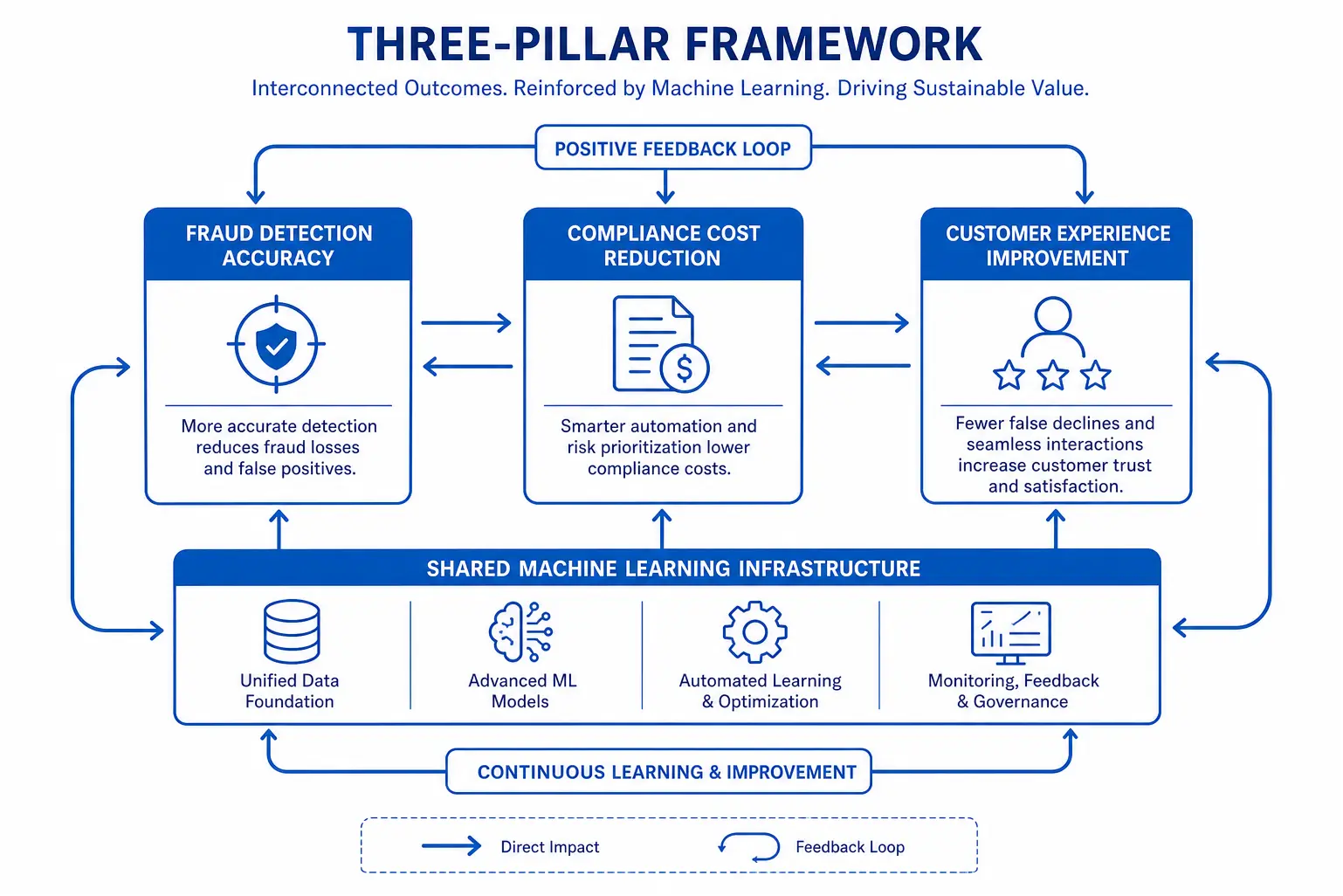
AI in financial services transforms these challenges into competitive advantages through three core capabilities: real-time pattern recognition across millions of data points, adaptive learning that evolves with emerging threats, and personalized customer experiences that increase lifetime value while reducing operational costs. Banks deploying ensemble machine learning models report 60-80% reductions in false positive alerts, compliance teams automate 70% of manual review workflows, and digital banking platforms predict customer churn with 85-92% accuracy. At H-in-Q.com, we’ve guided financial institutions through this transformation, from pilot projects screening 10,000 transactions daily to production systems handling 5 million+ events per second.
In this guide, you’ll discover exactly how machine learning reshapes fraud detection, compliance automation, and customer intelligence with implementation frameworks, regulatory requirements, cost benchmarks, and real-world case studies that prove ROI within 6-12 months.
What AI in Financial Services Actually Means for Modern Banking Operations
AI in financial services refers to the application of machine learning algorithms, natural language processing, and neural networks to automate decision-making, detect anomalies, ensure regulatory compliance, and personalize customer interactions at scale replacing manual processes that cannot keep pace with transaction volumes, fraud sophistication, or customer expectations in digital-first banking environments.
This definition matters because most financial institutions still conflate AI with simple automation or basic analytics. True AI systems learn from data without explicit programming, adapt to new patterns in real-time, and improve accuracy through continuous feedback loops. A rule-based fraud system requires manual updates every time criminals change tactics. A machine learning model trained on 10 million labeled transactions identifies suspicious patterns humans never programmed, then refines its detection logic automatically as new fraud types emerge.
The distinction becomes critical when evaluating vendor claims or building internal capabilities. Supervised learning models power fraud detection and credit risk assessment, requiring labeled historical data showing which transactions were fraudulent or which loans defaulted. Unsupervised learning identifies anomalies in customer behavior without predefined labels, flagging unusual patterns that might indicate account takeover or money laundering. Natural language processing analyzes unstructured text in customer service transcripts, loan applications, and regulatory filings extracting insights that structured databases miss entirely.
Financial services AI operates under constraints that don’t apply to other industries. Models must explain their decisions to regulators and customers, not just produce accurate predictions. They must handle class imbalance where fraud represents 0.1% of transactions but carries 100x the cost of false positives. They must process data in real-time approving or declining a transaction in under 100 milliseconds while maintaining audit trails that satisfy compliance requirements spanning multiple jurisdictions.
Why AI in Financial Services Matters for Businesses in 2026
The urgency driving AI adoption in banking stems from three converging pressures that traditional systems cannot address. First, fraud sophistication now outpaces human detection capabilities. Organized crime syndicates use machine learning to test stolen credentials across thousands of accounts simultaneously, identify vulnerable targets through social engineering automation, and generate synthetic identities that pass legacy verification checks. The Federal Trade Commission reported $10 billion in consumer fraud losses in 2023, with AI-enabled scams growing 300% faster than traditional fraud types.
Second, regulatory compliance costs consume 10-15% of operating budgets at major banks, with manual review processes creating bottlenecks that delay legitimate transactions by hours or days. Anti-money laundering programs generate 95-98% false positive rates, meaning compliance teams waste thousands of hours investigating legitimate activity while actual suspicious transactions slip through undetected. The European Banking Authority found that banks spend €780 per suspicious activity report, with only 2-3% resulting in actual enforcement actions.
Third, customer expectations have shifted irreversibly toward instant, personalized digital experiences. A 2024 Accenture study found that 68% of banking customers would switch institutions for better digital experiences, yet 73% of banks still rely on batch processing that updates customer profiles once daily. Real-time personalization requires AI systems that analyze transaction history, browsing behavior, life events, and external signals to deliver relevant product recommendations, proactive fraud alerts, and customized financial advice at the moment of interaction.
Institutions that delay AI implementation face a compounding disadvantage. Competitors using machine learning fraud detection approve 8-12% more legitimate transactions, translating directly to revenue growth. Banks with AI-powered compliance automation process regulatory reports 70% faster at 40% lower cost, freeing capital for customer-facing investments. Digital platforms leveraging churn prediction retain 15-25% more customers annually, compounding lifetime value advantages that become insurmountable over 3-5 year periods.
How to Implement AI in Financial Services: Step-by-Step Framework
Step 1: Identify High-Impact Use Cases with Clear ROI Metrics. Start with problems where AI delivers measurable improvements over existing processes within 6-12 months. Fraud detection, AML transaction monitoring, and customer churn prediction consistently show positive ROI in pilot phases. Define success metrics before building anything: false positive reduction targets, compliance review time savings, or customer retention lift. Avoid vague goals like “improve customer experience” specify that you’ll reduce account opening time from 12 minutes to under 3 minutes with 95% straight-through processing.
Step 2: Audit Data Quality and Establish Governance Frameworks. Machine learning models fail when trained on incomplete, biased, or inconsistent data. Conduct a data inventory covering transaction records, customer profiles, compliance case histories, and external data sources. Identify gaps where critical fields are missing or inconsistently populated. Establish data governance policies defining who owns each dataset, how often it updates, what quality standards apply, and how personally identifiable information gets anonymized for model training while maintaining regulatory compliance.
Step 3: Build Minimum Viable Models with Limited Scope. Deploy your first AI system on a constrained problem fraud detection for a single product line, compliance automation for one regulatory report type, or churn prediction for a specific customer segment. Use 70% of historical data for training, 15% for validation during development, and 15% for final testing on data the model has never seen. Establish baseline performance metrics from your existing system, then demonstrate that the AI model improves accuracy by at least 20% or reduces costs by at least 30% to justify broader investment.
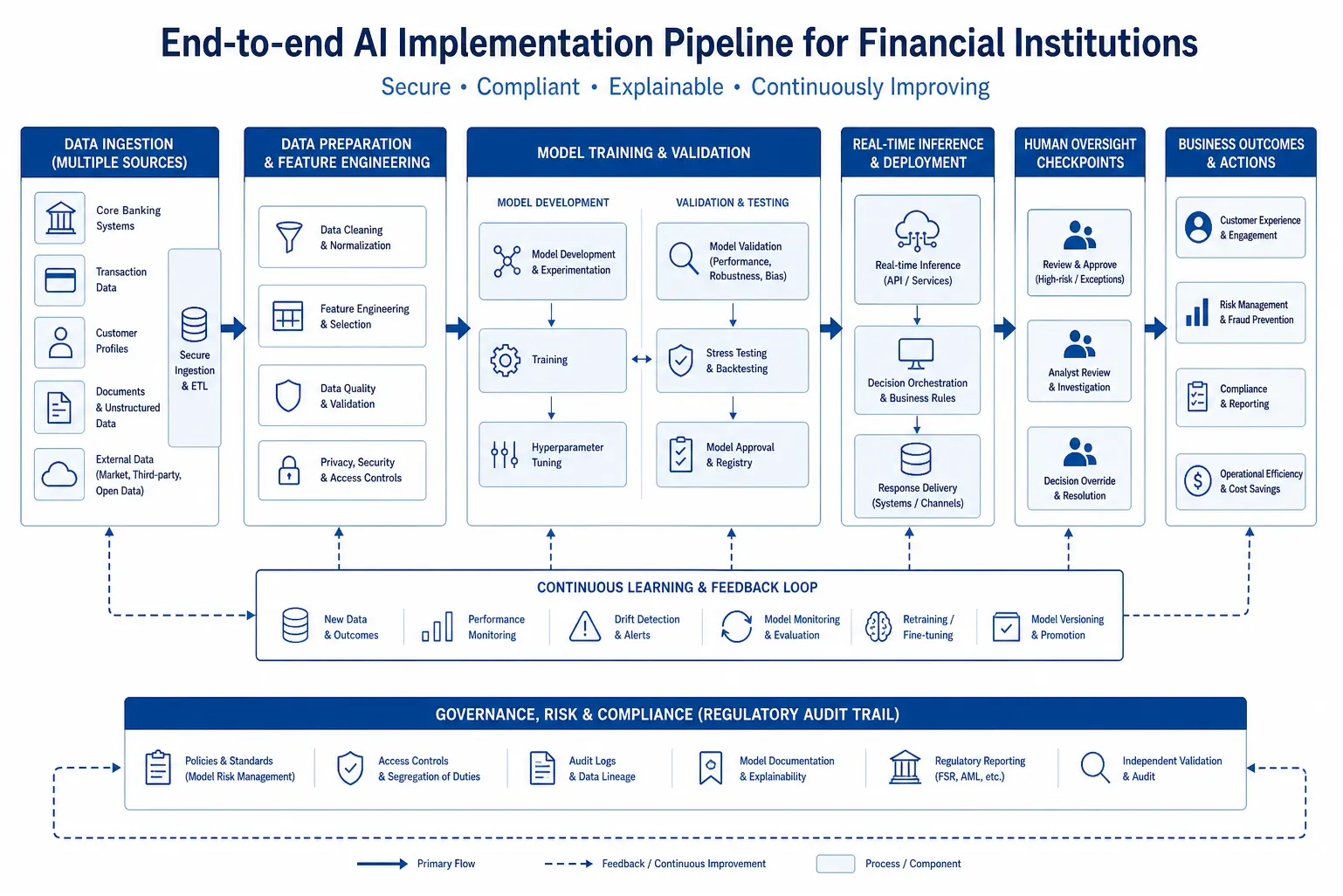
Step 4: Implement Human-in-the-Loop Workflows for Regulatory Compliance. Financial regulators require human oversight of AI decisions affecting customer outcomes. Design workflows where models flag high-confidence cases for automatic processing while routing edge cases to human reviewers. Set confidence thresholds based on business impact automatically approve transactions with 99%+ fraud scores below 1%, send 95-99% confidence cases to fast-track review, and route anything below 95% to full manual investigation. Track how often human reviewers override model recommendations to identify areas needing retraining.
Step 5: Deploy Shadow Mode Testing Before Production Launch. Run your AI system in parallel with existing processes for 60-90 days, generating predictions without affecting actual decisions. Compare model recommendations against what your current system decided and what the actual outcome was. Calculate precision (what percentage of fraud alerts were real), recall (what percentage of actual fraud was caught), and false positive rates across different customer segments, transaction types, and time periods. Use this data to tune decision thresholds and identify edge cases requiring additional training data.
Step 6: Scale Infrastructure for Real-Time Processing Requirements. Financial AI systems must process transactions in under 100 milliseconds to avoid customer-facing latency. This requires distributed computing infrastructure, in-memory data stores, and model serving platforms optimized for low-latency inference. Cloud providers offer managed services handling auto-scaling, but on-premises deployments give you more control over data sovereignty and regulatory compliance. Budget for 3-5x your pilot infrastructure costs when moving to production scale a model processing 10,000 daily transactions in pilot phase needs fundamentally different architecture to handle 5 million.
Step 7: Establish Continuous Learning and Model Monitoring Pipelines. AI models degrade over time as fraud tactics evolve, customer behavior shifts, and regulatory requirements change. Implement automated monitoring tracking prediction accuracy, processing latency, and data drift when the statistical properties of incoming data diverge from training data. Set up retraining pipelines that automatically incorporate new labeled examples, A/B test updated models against production versions, and roll out improvements without service disruptions. Plan for quarterly model refreshes at minimum, with weekly or daily updates for high-stakes fraud detection systems.
Step 8: Document Everything for Regulatory Audits and Model Explainability. Maintain detailed records of training data sources, feature engineering decisions, model architecture choices, hyperparameter tuning experiments, and performance test results. For every model prediction affecting a customer, store the input features, model version, confidence score, and decision rationale in a format that compliance teams can retrieve during audits. Implement SHAP values or LIME explanations showing which features most influenced each prediction, enabling you to explain to regulators and customers exactly why the model flagged a transaction as suspicious or declined a loan application.
Best Practices for AI Implementation in Regulated Financial Environments
1. Start with Supervised Learning Before Exploring Advanced Architectures. Random forests, gradient boosting machines, and logistic regression deliver 80-90% of the performance of complex neural networks with 10x faster training times and far better explainability. Reserve deep learning for problems with massive unstructured datasets image processing for check deposits, NLP for customer service transcripts where simpler models cannot capture the necessary patterns. Most fraud detection and credit risk applications work better with ensemble methods that combine multiple simple models.
2. Address Class Imbalance with Proper Sampling and Cost Functions. When fraud represents 0.1% of transactions, a model that predicts “not fraud” for everything achieves 99.9% accuracy while catching zero actual fraud. Use stratified sampling to ensure training batches include representative fraud examples, apply SMOTE or other synthetic oversampling techniques to balance classes, and customize loss functions to penalize false negatives 100-1000x more than false positives based on your actual business costs.
3. Build Separate Models for Different Customer Segments and Product Lines. A single fraud detection model trained on all transactions performs worse than segment-specific models because fraud patterns differ dramatically between credit cards, wire transfers, and mobile payments. Customer behavior varies by age, geography, and account tenure a transaction flagged as suspicious for a 70-year-old retiree might be perfectly normal for a 25-year-old frequent traveler. Segment-specific models reduce false positives by 30-50% compared to one-size-fits-all approaches.
4. Combine Multiple Data Sources Beyond Transaction History. The most effective AI systems fuse transactional data with device fingerprinting, geolocation, behavioral biometrics, social network graphs, and external threat intelligence. A wire transfer might look legitimate based on amount and recipient, but becomes suspicious when combined with the fact that the user logged in from a new device, in a different country, using a VPN, immediately after receiving a phishing email. Feature engineering that captures these contextual signals improves model accuracy by 15-25%.
5. Implement Adversarial Testing to Identify Model Vulnerabilities. Criminals actively probe AI systems to identify weaknesses they can exploit. Run your own adversarial tests where you attempt to fool the model with synthetic fraud patterns, gradually modified legitimate transactions, or carefully crafted input features. Document which attack vectors succeed, then retrain models with adversarial examples in the training set. This counterintuitive practice deliberately attacking your own systems prevents real criminals from discovering the same vulnerabilities first.
6. Establish Clear Escalation Paths for Model Failures. AI systems will make mistakes the question is whether you detect and correct them quickly or let errors compound. Define alert thresholds for sudden accuracy drops, unusual prediction distributions, or processing latency spikes. Create runbooks specifying exactly who gets notified, what diagnostic steps they follow, and when you roll back to the previous model version versus patching the current one. Practice incident response drills quarterly so teams can execute under pressure.
How AI Is Changing Financial Services in 2026
The transformation happening across banking, insurance, and investment management in 2026 centers on three fundamental shifts. First, AI has moved from experimental pilots to production infrastructure handling the majority of operational workflows. Major banks now process 60-80% of fraud investigations, compliance reviews, and customer service inquiries through automated systems, with human experts handling only the most complex or sensitive cases. This isn’t about replacing people it’s about eliminating the repetitive pattern-matching tasks that humans perform inconsistently while freeing them for judgment-intensive work requiring empathy, creativity, and ethical reasoning.
Second, real-time personalization has become table stakes rather than a competitive differentiator. Customers expect their banking app to know they just moved cities, started a new job, or had a baby and proactively offer relevant products, adjust credit limits, or flag unusual account activity that might indicate fraud. The AI systems powering these experiences analyze hundreds of signals per customer daily, updating risk profiles and recommendation engines continuously rather than in overnight batch processes. The institutions winning market share in 2026 are those that deployed these capabilities 18-24 months ago and have been refining them through millions of customer interactions.
Third, regulatory frameworks have evolved to explicitly address AI governance, model risk management, and algorithmic accountability. The EU AI Act, US Federal Reserve guidance, and similar regulations worldwide now require financial institutions to document training data provenance, demonstrate fairness across demographic groups, and explain individual predictions to customers and auditors. This regulatory clarity has accelerated AI adoption by establishing clear compliance requirements, but it has also raised the bar for implementation quality institutions cannot deploy black-box models and hope regulators don’t notice.
The competitive landscape has stratified into three tiers. Leaders like HSBC, JPMorgan Chase, and Ant Financial operate AI systems processing billions of transactions monthly, with dedicated teams of 50-200 data scientists continuously improving model performance. Fast followers have deployed vendor solutions or partnered with specialized AI firms to implement production systems within 12-18 months. Laggards still running rule-based systems face mounting customer attrition, regulatory pressure, and fraud losses that compound quarterly. Organizations like H-in-Q.com help financial institutions accelerate their AI maturity, providing implementation frameworks, regulatory guidance, and technical expertise that compress timelines from 24 months to 9-12 months without sacrificing quality or compliance.
Essential Tools and Platforms for Financial Services AI Implementation
DataRobot and H2O.ai provide automated machine learning platforms that handle feature engineering, model selection, and hyperparameter tuning reducing the time to build production-grade fraud detection or credit risk models from months to weeks. Both offer financial services-specific templates and pre-built connectors for core banking systems. Pricing starts at $50,000 annually for mid-sized institutions, with enterprise deployments ranging from $300,000-$1 million based on transaction volumes and user counts.
AWS SageMaker, Google Cloud Vertex AI, and Azure Machine Learning deliver managed infrastructure for training and deploying custom models at scale. These platforms handle the operational complexity of distributed computing, model versioning, and real-time inference endpoints. Cloud-native approaches reduce infrastructure costs by 40-60% compared to on-premises deployments while offering auto-scaling that matches processing capacity to transaction volumes. Most financial institutions use hybrid architectures cloud for model development and testing, on-premises for production systems handling sensitive customer data.
FICO Falcon Fraud Manager and SAS Fraud Detection represent mature commercial solutions with decades of financial services expertise built into pre-configured models and workflows. These platforms require less customization than building from scratch, but offer less flexibility for unique use cases. Implementation timelines run 6-12 months, with total cost of ownership ranging from $500,000 to $5 million over three years depending on transaction volumes and customization requirements.
TensorFlow, PyTorch, and Scikit-learn provide open-source frameworks for organizations building custom AI systems in-house. These tools offer maximum flexibility and avoid vendor lock-in, but require significant data science expertise and engineering resources. Financial institutions with teams of 10+ data scientists often choose this path, achieving 60-80% cost savings compared to commercial platforms while maintaining full control over intellectual property and model architectures.
Elasticsearch and Apache Kafka handle the data infrastructure requirements for real-time AI systems ingesting transaction streams, maintaining searchable audit logs, and distributing events to multiple downstream models simultaneously. These technologies form the backbone of production architectures processing millions of events per second with sub-100 millisecond latency requirements.
Evidently AI and Fiddler specialize in model monitoring and explainability tracking prediction accuracy, detecting data drift, and generating human-readable explanations for individual model decisions. Regulatory compliance increasingly requires these capabilities, making them essential components of any financial services AI stack rather than optional add-ons.
Building Sustainable AI Capabilities in Financial Institutions
The financial services industry has reached an inflection point where AI capabilities separate market leaders from institutions struggling with legacy constraints. Machine learning systems that detect fraud with 90%+ accuracy, automate 70% of compliance workflows, and predict customer churn with precision exceeding 85% are no longer experimental they’re production infrastructure at institutions processing trillions in annual transaction volume. The question facing every bank, credit union, and fintech platform is not whether to implement AI, but how quickly they can deploy systems that deliver measurable ROI while satisfying regulatory requirements for explainability, fairness, and human oversight.
The institutions succeeding in this transformation share common characteristics. They start with narrowly defined use cases where AI delivers clear improvements over existing processes within 6-12 months. They invest in data quality and governance before building models, recognizing that algorithmic sophistication cannot compensate for incomplete or biased training data. They implement human-in-the-loop workflows that leverage AI for pattern recognition while preserving human judgment for edge cases requiring empathy or ethical reasoning. They establish continuous learning pipelines that automatically incorporate new fraud patterns, regulatory changes, and customer behavior shifts ensuring models improve rather than degrade over time.
The path from pilot to production requires more than technical expertise. It demands organizational change management, regulatory navigation, and vendor ecosystem coordination that most financial institutions have never attempted at this scale. Success depends on building internal capabilities while partnering with specialists who have guided dozens of implementations through the specific challenges that arise when deploying AI in financial services at transaction volumes exceeding millions per day. The institutions that master this balance will define the competitive landscape for the next decade, while those that delay face mounting disadvantages in fraud losses, compliance costs, and customer attrition that compound quarterly.
Ready to transform your financial institution’s fraud detection, compliance automation, and customer intelligence capabilities? Explore how H-in-Q.com can help you implement production-scale AI systems that deliver measurable ROI while satisfying regulatory requirements. The window for competitive advantage is narrowing every quarter of delay represents millions in preventable fraud losses, compliance inefficiencies, and customer attrition that your AI-enabled competitors are capturing instead.
Frequently Asked Questions
How accurate is AI fraud detection compared to traditional rule-based systems?
AI fraud detection achieves 90-95% accuracy with false positive rates below 5%, compared to 60-70% accuracy and 20-30% false positive rates for rule-based systems. Machine learning models adapt to new fraud patterns in real-time, while traditional systems require manual rule updates that lag behind evolving threats.
What regulatory requirements exist for AI model explainability in banking?
Financial regulators require documentation of model logic, training data sources, performance metrics, and decision rationale for any AI system affecting customer outcomes. The EU AI Act, US Federal Reserve SR 11-7, and similar frameworks mandate human oversight, bias testing, and the ability to explain individual predictions to customers and auditors.
Can small regional banks afford enterprise AI fraud detection systems?
Yes, cloud-based AI platforms now offer pay-per-transaction pricing starting at $0.001-0.01 per transaction, making enterprise-grade fraud detection accessible to institutions processing 100,000+ monthly transactions. Open-source frameworks like TensorFlow and PyTorch reduce development costs by 60-80% compared to proprietary solutions.
How long does it take to implement AI-powered compliance automation?
Pilot implementations typically require 3-6 months for data integration, model training, and initial testing. Full production deployment across all compliance workflows takes 9-18 months depending on institution size, legacy system complexity, and regulatory approval processes. Quick wins in document processing and transaction monitoring often deliver ROI within the first quarter.
What is the ROI of AI-powered customer churn prediction in digital banking?
Banks implementing churn prediction models report 15-25% reductions in customer attrition, translating to $2-5 million annual savings per 100,000 customers. Proactive retention campaigns targeting high-risk segments achieve 3-5x higher success rates than blanket marketing, with typical payback periods of 6-12 months.
Do AI chatbots actually improve customer satisfaction in banking?
NLP-powered banking chatbots resolve 70-80% of routine inquiries without human intervention, reducing wait times from 8-12 minutes to under 30 seconds. Customer satisfaction scores increase 12-18 percentage points when chatbots handle tier-one support, freeing human agents for complex issues requiring empathy and judgment.