Table of Contents
- What AI Market Research Methods Are and How They Work
- Why AI Market Research Methods Matter for Businesses in 2026
- How to Implement AI Market Research Methods: Step-by-Step Framework
- Best Practices for Maximizing AI Market Research ROI
- How AI Is Changing Market Research in 2026
- Essential Tools and Platforms for AI Market Research
- Turning Market Intelligence Into Revenue Growth
- Frequently Asked Questions
Companies using AI market research methods are bringing products to market 40% faster than competitors still relying on traditional focus groups and manual surveys. The gap between organizations that harness machine learning for customer insights and those that don’t is widening every quarter, creating measurable differences in revenue growth, market share, and product-market fit accuracy.
Traditional market research delivers answers in weeks or months. AI-powered approaches provide real-time intelligence that updates as customer sentiment shifts, competitive landscapes evolve, and market opportunities emerge. This speed advantage translates directly into strategic agility: the ability to pivot product roadmaps based on actual behavioral signals rather than delayed survey responses collected weeks after customer opinions formed.
Product teams face mounting pressure to validate assumptions faster, reduce development risk, and allocate resources to features that demonstrably drive adoption. AI market research methods address these challenges by automating data collection across dozens of sources, applying natural language processing to extract themes from millions of customer interactions, and using predictive analytics to forecast market response before launch. H-in-Q.com has implemented these systems for global brands, consistently demonstrating that the right AI infrastructure transforms market research from a periodic checkpoint into a continuous strategic asset.
In this guide, you’ll discover the specific AI market research methods that Fortune 500 companies use to cut research costs by 30-50%, the step-by-step process for building your own AI-powered insight pipeline, and the tools that deliver measurable ROI within the first quarter of implementation.
What AI Market Research Methods Are and How They Work
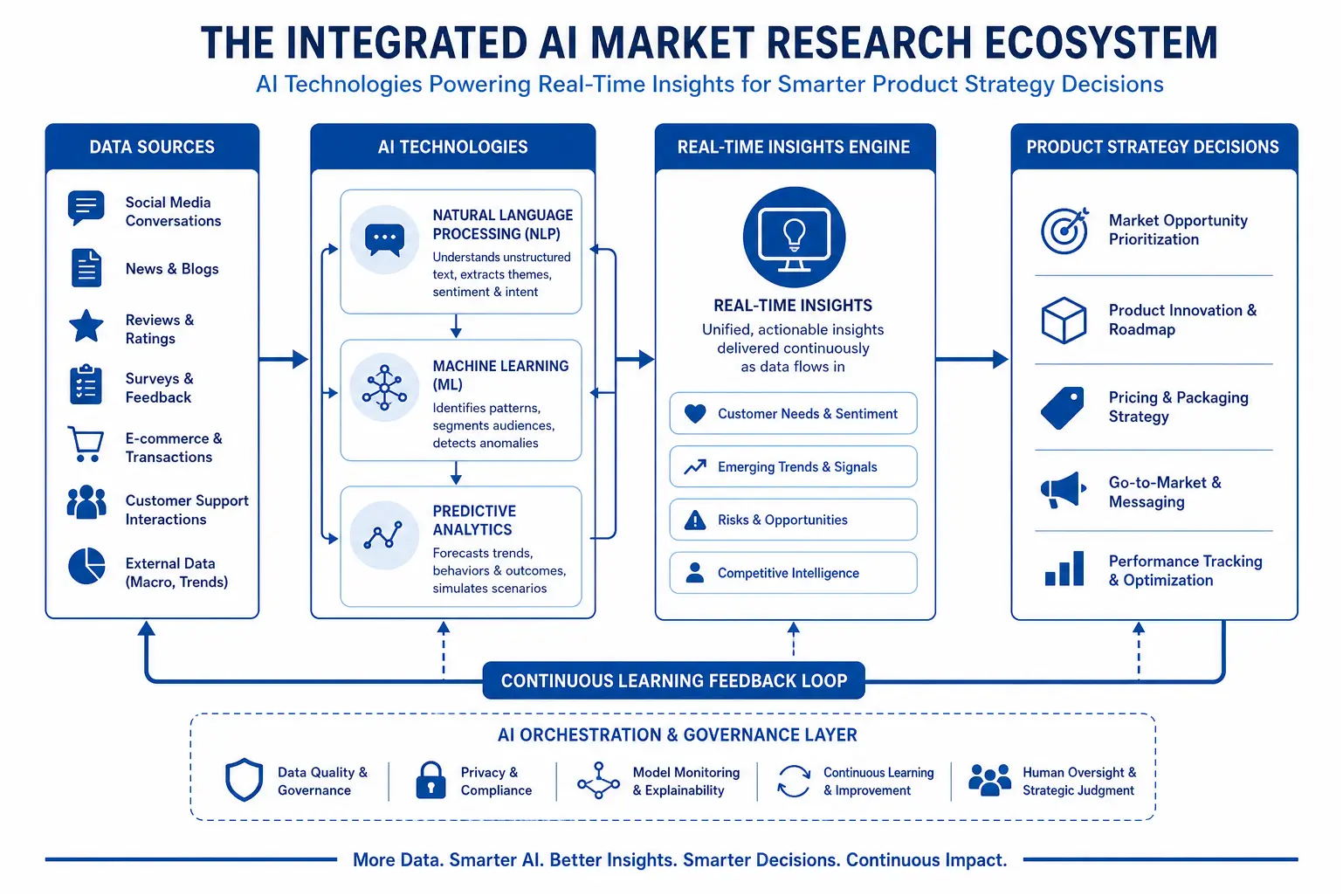
AI market research methods are systematic approaches that use machine learning algorithms, natural language processing, and predictive analytics to collect, analyze, and interpret customer data at scale, transforming unstructured feedback from reviews, social media, surveys, and behavioral signals into actionable product strategy insights with minimal human intervention.
These methods differ fundamentally from traditional research in three ways: automation of data collection across multiple channels simultaneously, application of statistical models that identify patterns invisible to human analysts, and continuous learning systems that improve accuracy as they process more data. A traditional conjoint analysis might survey 500 people over two weeks to understand feature preferences. An AI-powered approach analyzes millions of product reviews, support tickets, and usage logs in hours, identifying not just stated preferences but revealed preferences through actual behavior.
The core technologies include supervised learning models trained to classify customer sentiment, unsupervised clustering algorithms that segment audiences based on behavioral patterns, and neural networks that predict market response to product variations. Natural language processing extracts structured insights from unstructured text, while computer vision analyzes visual content like product photos customers share on social platforms. Time series forecasting models identify emerging trends before they appear in traditional research channels.
The practical output is a continuous intelligence feed rather than periodic reports. Product managers receive alerts when sentiment around specific features shifts, competitive intelligence systems flag new market entrants or positioning changes, and recommendation engines suggest which customer segments to target with upcoming releases based on predicted receptivity scores.
Why AI Market Research Methods Matter for Businesses in 2026
The cost of wrong product decisions has never been higher. According to CB Insights analysis of startup failures, 35% of companies fail because they build products nobody wants, a problem that robust market research directly addresses. Traditional methods reduce this risk but introduce a different problem: speed. The median time from concept to launch for consumer products is 18-24 months, yet customer preferences and competitive dynamics shift dramatically in that window.
AI market research methods compress decision cycles while improving accuracy. Unilever reduced product development costs by 40% using AI consumer insight platforms that analyze social media conversations, e-commerce reviews, and search behavior to predict which product variations will succeed before manufacturing a single unit. This approach eliminated three rounds of traditional focus groups and two waves of concept testing, saving 14 weeks per product launch while increasing first-year sales performance by 23%.
The financial impact extends beyond cost savings. Companies using predictive analytics for market research achieve 15-20% higher revenue growth than industry peers, according to McKinsey research on AI adoption in consumer goods. This advantage comes from three sources: earlier identification of market opportunities, more accurate demand forecasting that optimizes inventory and marketing spend, and faster iteration cycles that allow teams to test and refine products based on real customer signals rather than assumptions.
Businesses that ignore AI market research methods face a compounding disadvantage: competitors using these tools make better decisions faster, creating a gap that widens with each product cycle. The question is no longer whether to adopt AI-powered research but how quickly you can implement systems that turn customer data into competitive advantage.
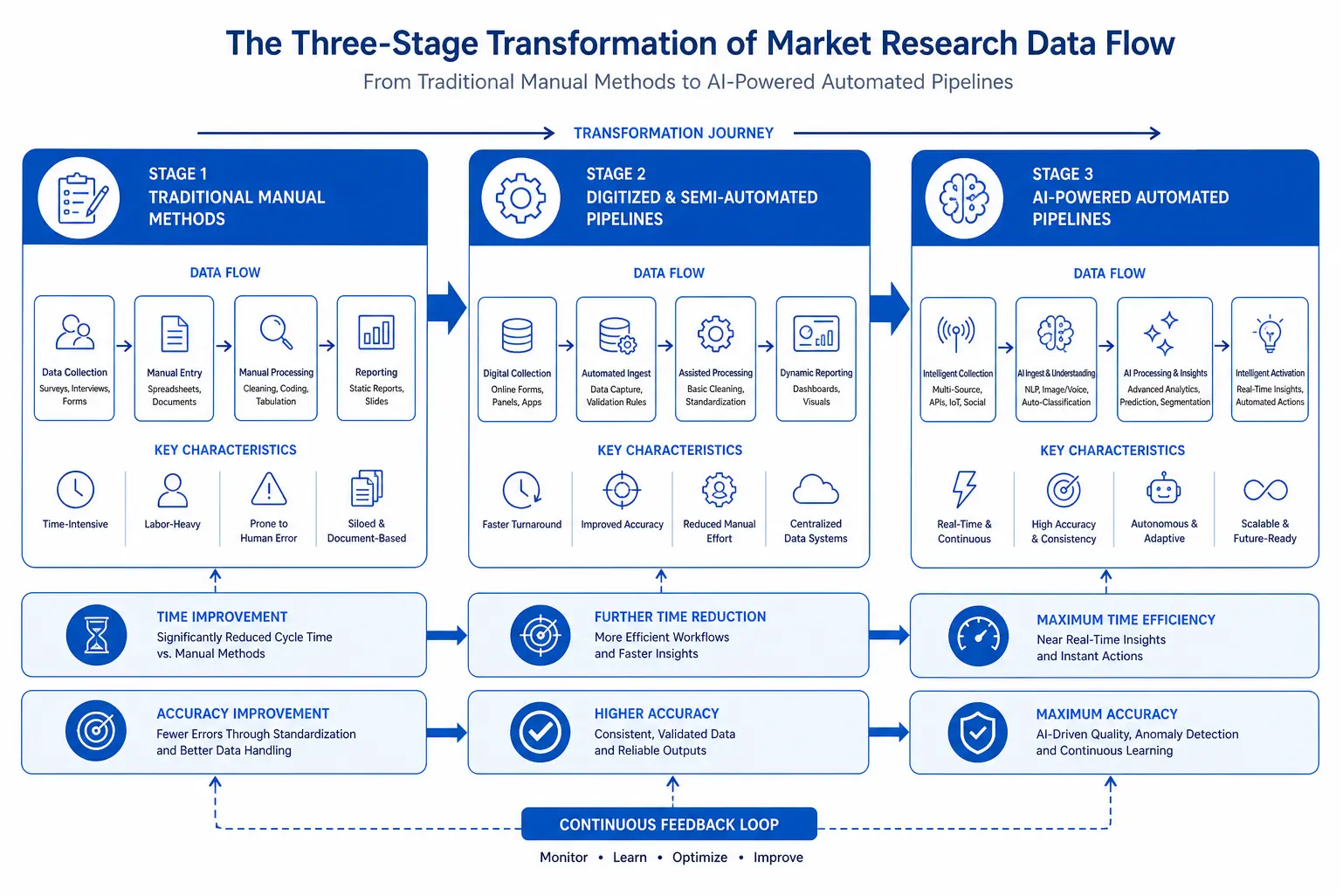
How to Implement AI Market Research Methods: Step-by-Step Framework
Step 1: Define specific business questions your research must answer. Start with concrete decisions you need to make: which features to prioritize in the next release, which customer segment to target with marketing spend, or whether to enter a new market category. AI systems perform best when optimized for specific questions rather than general exploration. Document your success metrics before collecting any data.
Step 2: Identify and integrate your data sources. Connect systems where customer feedback already exists: CRM platforms, support ticket databases, social media monitoring tools, survey platforms, product analytics, and sales call recordings. Most organizations already collect 60-80% of the data they need but store it in disconnected silos. Use API integrations or data warehouses to create a unified dataset. Prioritize sources with the highest signal-to-noise ratio for your specific questions.
Step 3: Select AI models appropriate for your data types and questions. Sentiment analysis models work for understanding customer satisfaction from text feedback. Clustering algorithms segment customers based on behavioral patterns. Regression models predict outcomes like churn or lifetime value. Conjoint analysis powered by machine learning reveals feature preferences from choice data. Match the model to your question: classification for categorization tasks, regression for prediction, clustering for segmentation.
Step 4: Train models on domain-specific data with human validation. Generic pre-trained models achieve 70-75% accuracy on business data. Fine-tuning on your industry, product category, and customer language improves accuracy to 85-92%. Have domain experts label a subset of data (typically 1,000-5,000 examples) to teach models your specific context. A retail sentiment model needs to understand that “fire” means positive in sneaker reviews but negative in electronics reviews.
Step 5: Establish validation protocols and accuracy benchmarks. Compare AI-generated insights against a holdout dataset where outcomes are known. Measure precision (how many identified patterns are real) and recall (how many real patterns the system finds). Set minimum accuracy thresholds before deploying insights to decision-makers. Track prediction accuracy over time and retrain models quarterly as customer language and market conditions evolve.
Step 6: Build dashboards that translate model outputs into business recommendations. Data scientists understand confusion matrices and ROC curves. Product managers need clear answers: “Launch feature A before feature B” or “Target segment X with this messaging.” Create visualization layers that show confidence levels, supporting evidence, and recommended actions. Include drill-down capabilities so users can examine the underlying data when they question a recommendation.
Step 7: Create feedback loops that improve model performance. Track which AI-generated recommendations led to successful outcomes and which missed the mark. Feed this performance data back into training pipelines so models learn from their mistakes. Establish regular review sessions where product teams discuss AI insights that proved valuable versus those that didn’t, creating a continuous improvement cycle.
Step 8: Scale from pilot projects to enterprise-wide deployment. Start with one high-value use case, prove ROI, then expand. A typical progression: sentiment analysis on customer reviews (month 1-2), competitive intelligence monitoring (month 3-4), predictive demand forecasting (month 5-6), full voice-of-customer integration (month 7-12). Each phase builds on the previous infrastructure while demonstrating incremental value.
Best Practices for Maximizing AI Market Research ROI
1. Combine AI insights with human expertise rather than replacing analysts. AI excels at processing millions of data points and identifying patterns. Humans excel at understanding context, asking better questions, and connecting insights to strategic decisions. The highest-performing teams use AI to surface signals and humans to interpret significance. Analysts spend 70% less time on data processing and 70% more time on strategic interpretation.
2. Prioritize behavioral data over stated preferences. Customers say they want privacy features but choose products based on convenience. AI market research methods shine when analyzing what customers actually do: which features they use, where they abandon workflows, what content they share. Behavioral signals predict future actions 3-4x more accurately than survey responses about hypothetical scenarios.
3. Implement real-time monitoring instead of periodic research waves. Traditional research delivers snapshots. AI systems provide continuous monitoring that detects shifts as they happen. Set up alerts for significant changes in sentiment, competitive positioning, or emerging customer needs. Companies using real-time monitoring identify market opportunities 8-12 weeks earlier than competitors relying on quarterly research cycles.
4. Validate AI findings with small-scale experiments before major commitments. When AI models suggest a product direction, test with a minimum viable version before full development. Use A/B tests, limited releases, or crowdfunding campaigns to validate predictions with actual customer behavior. This approach combines AI’s pattern recognition with empirical validation, reducing the risk of false positives.
5. Focus on prediction accuracy for high-stakes decisions, speed for low-stakes ones. Not all decisions require 95% confidence. Choosing a blog post topic can rely on 70% accuracy because the downside is minimal. Deciding whether to build a new product line requires higher confidence and additional validation. Calibrate your accuracy requirements to decision stakes, using faster, less precise methods where appropriate.
6. Build cross-functional access to insights, not just research team access. When only researchers see AI-generated insights, adoption remains limited. Create role-specific dashboards for product managers, marketers, sales teams, and executives. Each group needs different views of the same underlying intelligence. Product teams want feature prioritization. Marketing wants messaging insights. Sales wants objection handling intelligence.
7. Document the business impact of AI-driven decisions to build organizational trust. Track which product decisions were influenced by AI insights and measure outcomes: revenue impact, time-to-market reduction, cost savings. Share success stories and lessons learned. Organizations with high AI adoption maintain internal case study libraries showing specific instances where AI market research drove measurable results.
How AI Is Changing Market Research in 2026
The market research industry is experiencing its most significant transformation in 50 years. Large language models now analyze open-ended survey responses with nuance that matches expert human coders, reducing analysis time from weeks to hours while identifying themes that manual review misses. GPT-4 and Claude can process 10,000 survey responses, extract key themes, identify sentiment, and generate executive summaries in under an hour at a cost of less than $50.
Synthetic respondent models represent the most controversial advancement. These AI systems, trained on millions of actual customer responses, can simulate how specific customer segments would respond to new product concepts or marketing messages. Early validation studies show 80-85% agreement between synthetic and real responses for concept testing scenarios. While synthetic models cannot replace real customer feedback for final validation, they enable rapid iteration on concepts before expensive primary research.
Computer vision now extracts market intelligence from visual content at scale. AI systems analyze millions of Instagram posts to understand how customers actually use products, identify unmet needs based on product modifications people make, and detect emerging aesthetic trends months before they appear in traditional trend reports. Fashion brands use these systems to inform design decisions based on what styles generate engagement rather than relying solely on runway trends.
Predictive market sizing has evolved from educated guesswork to statistical modeling. AI systems analyze search volume trends, social media conversation growth, competitor revenue patterns, and analogous market adoption curves to forecast total addressable market with increasing accuracy. These models update continuously as new data arrives, providing dynamic market size estimates rather than static reports.
H-in-Q.com’s approach to AI market research implementation focuses on building systems that integrate seamlessly with existing product development workflows rather than creating separate research functions. The goal is embedding intelligence directly into decision points: when a product manager opens a feature prioritization meeting, they see real-time sentiment data and predicted adoption scores. When a marketing team plans a campaign, they access AI-generated customer segment profiles with messaging recommendations based on actual language patterns.
Essential Tools and Platforms for AI Market Research
Crayon provides competitive intelligence automation that tracks competitor website changes, pricing updates, product launches, and marketing campaigns across thousands of sources. The platform uses machine learning to identify significant changes and alert teams to competitive threats or opportunities. Pricing starts at $600/month for small teams.
Qualtrics with Text iQ combines traditional survey capabilities with AI-powered text analysis that automatically categorizes open-ended responses, identifies sentiment, and surfaces emerging themes. The platform integrates with CRM and support systems to create unified customer feedback repositories. Enterprise pricing typically ranges from $30,000-$100,000 annually depending on volume.
MonkeyLearn offers no-code text analysis tools that product teams can use to build custom sentiment analysis, keyword extraction, and categorization models without data science expertise. The platform works with survey data, customer reviews, support tickets, and social media content. Plans start at $299/month with free trials available.
Brandwatch Consumer Intelligence monitors social media conversations across platforms, analyzing billions of posts to identify brand sentiment, emerging trends, and customer pain points. The AI engine detects sarcasm, context, and nuanced opinions that simple keyword monitoring misses. Pricing is custom based on data volume and user count.
Conjointly automates conjoint analysis and MaxDiff studies using Bayesian statistical methods and machine learning to determine optimal product configurations and feature priorities. The platform handles study design, respondent recruitment, and analysis, delivering results in days rather than weeks. Self-service plans start at $1,500 per study.
Zappi provides AI-powered ad testing and concept validation that predicts market performance before launch. The platform uses a database of 500,000+ tested concepts to benchmark new ideas and identify optimization opportunities. Subscription pricing varies based on testing volume and market coverage.
Turning Market Intelligence Into Revenue Growth
AI market research methods have evolved from experimental technology to essential infrastructure for product-driven organizations. The companies achieving measurable results share common characteristics: they treat market research as a continuous process rather than periodic projects, they integrate AI-generated insights directly into decision workflows, and they combine automated analysis with human strategic thinking.
The practical advantages are clear and quantifiable. Research costs decrease by 30-50% as automation replaces manual data processing. Time-to-market improves by 40% when teams access real-time intelligence instead of waiting for research reports. Product-market fit accuracy increases because decisions rely on behavioral signals from millions of customers rather than opinions from hundreds of survey respondents.
Implementation success depends on starting with specific business questions, building on data you already collect, and proving value with pilot projects before enterprise-wide deployment. The organizations that move first gain compounding advantages as their AI systems learn from more data and their teams develop expertise in translating insights into strategy. Explore how H-in-Q.com can help your team build AI market research capabilities that drive measurable revenue growth. The gap between AI-powered market intelligence and traditional research methods will only widen as these technologies mature and become more sophisticated.
Frequently Asked Questions
What is the ROI of implementing AI market research methods?
Companies implementing AI market research methods typically see 30-50% reduction in research costs and 40% faster time-to-market. The ROI comes from automated data collection, real-time sentiment analysis, and predictive models that eliminate weeks of manual analysis while improving accuracy by 25-35% compared to traditional methods.
How accurate is AI-powered sentiment analysis compared to human analysis?
Modern AI sentiment analysis achieves 85-92% accuracy when properly trained on domain-specific data, matching or exceeding human analyst performance. The advantage lies in consistency across millions of data points, elimination of human bias, and the ability to detect nuanced emotional patterns that manual review often misses.
What data sources do AI market research tools analyze?
AI market research tools analyze customer reviews, social media conversations, support tickets, survey responses, sales call transcripts, product usage data, and competitive intelligence feeds. Advanced systems integrate structured data from CRM platforms with unstructured text, voice, and video data to create comprehensive customer insight profiles.
Can small businesses benefit from AI market research methods?
Small businesses gain significant advantages from AI market research through accessible cloud-based tools that require minimal technical expertise. Platforms now offer pay-as-you-go pricing starting at $99/month, democratizing capabilities that previously required six-figure research budgets and dedicated data science teams.
How long does it take to implement an AI market research system?
Basic AI market research implementation takes 4-8 weeks for initial setup and training. This includes data source integration, model customization for your industry, team training, and validation testing. Full enterprise deployment with custom models and multiple data pipelines typically requires 3-4 months.
What skills does my team need to use AI market research tools?
Teams need basic data literacy and familiarity with analytics dashboards rather than technical AI expertise. Most platforms provide no-code interfaces for setting up sentiment analysis, generating reports, and building predictive models. One team member with SQL knowledge helps with custom data queries but is not mandatory.