Table of Contents
- Understanding AI-Powered Customer Experience Fundamentals
- AI Chatbots and Conversational Intelligence
- Sentiment Analysis and Emotional Intelligence
- Personalization Engines and Individualized Experiences
- Voice AI and Intelligent Call Centers
- Customer Journey Mapping and Optimization
- Implementation Strategy and Best Practices
- Measuring AI CX Success and ROI
- The Future of AI-Powered Customer Experience
- Frequently Asked Questions
The landscape of customer experience is undergoing a fundamental transformation as AI-powered customer experience solutions reshape how businesses interact with their customers. Artificial intelligence is no longer a futuristic concept—it’s a present-day necessity that enables organizations to deliver personalized, efficient, and proactive customer service at unprecedented scale. From intelligent chatbots that resolve issues in seconds to predictive analytics that anticipate needs before customers even articulate them, AI is redefining what exceptional customer experience looks like in the digital age.
Today’s customers expect instant responses, personalized interactions, and seamless experiences across all touchpoints. Traditional customer service models simply cannot meet these demands without exponential increases in staffing and costs. AI bridges this gap by automating routine tasks, analyzing vast amounts of customer data in real-time, and enabling businesses to deliver consistent, high-quality experiences 24/7. Companies implementing AI-driven CX strategies report satisfaction score improvements of 20-30%, cost reductions of up to 40%, and significant competitive advantages in customer retention.
Understanding AI-Powered Customer Experience Fundamentals
AI-powered customer experience encompasses a broad ecosystem of technologies working together to enhance every stage of the customer journey. At its core, it leverages machine learning algorithms, natural language processing, computer vision, and predictive analytics to understand, anticipate, and respond to customer needs with minimal human intervention.
The foundation of effective AI CX implementation rests on three pillars: data collection and integration, intelligent automation, and continuous learning. Organizations must first consolidate customer data from multiple sources—CRM systems, interaction histories, social media, purchase records, and behavioral analytics—to create comprehensive customer profiles. This unified data foundation enables AI systems to develop contextual understanding and deliver truly personalized experiences.
Machine learning models then analyze patterns within this data to automate decision-making, predict outcomes, and optimize interactions. Unlike rule-based systems, AI continuously improves through feedback loops, learning from every customer interaction to refine its responses and recommendations. This self-improving capability represents the fundamental difference between traditional automation and true artificial intelligence in customer experience applications.
AI Chatbots and Conversational Intelligence
Conversational AI has emerged as the most visible and widely adopted application of artificial intelligence in customer service. Modern AI chatbots go far beyond simple scripted responses, utilizing natural language understanding to interpret customer intent, context, and sentiment. These intelligent assistants can handle complex multi-turn conversations, switch between topics naturally, and escalate to human agents when situations require emotional intelligence or creative problem-solving.
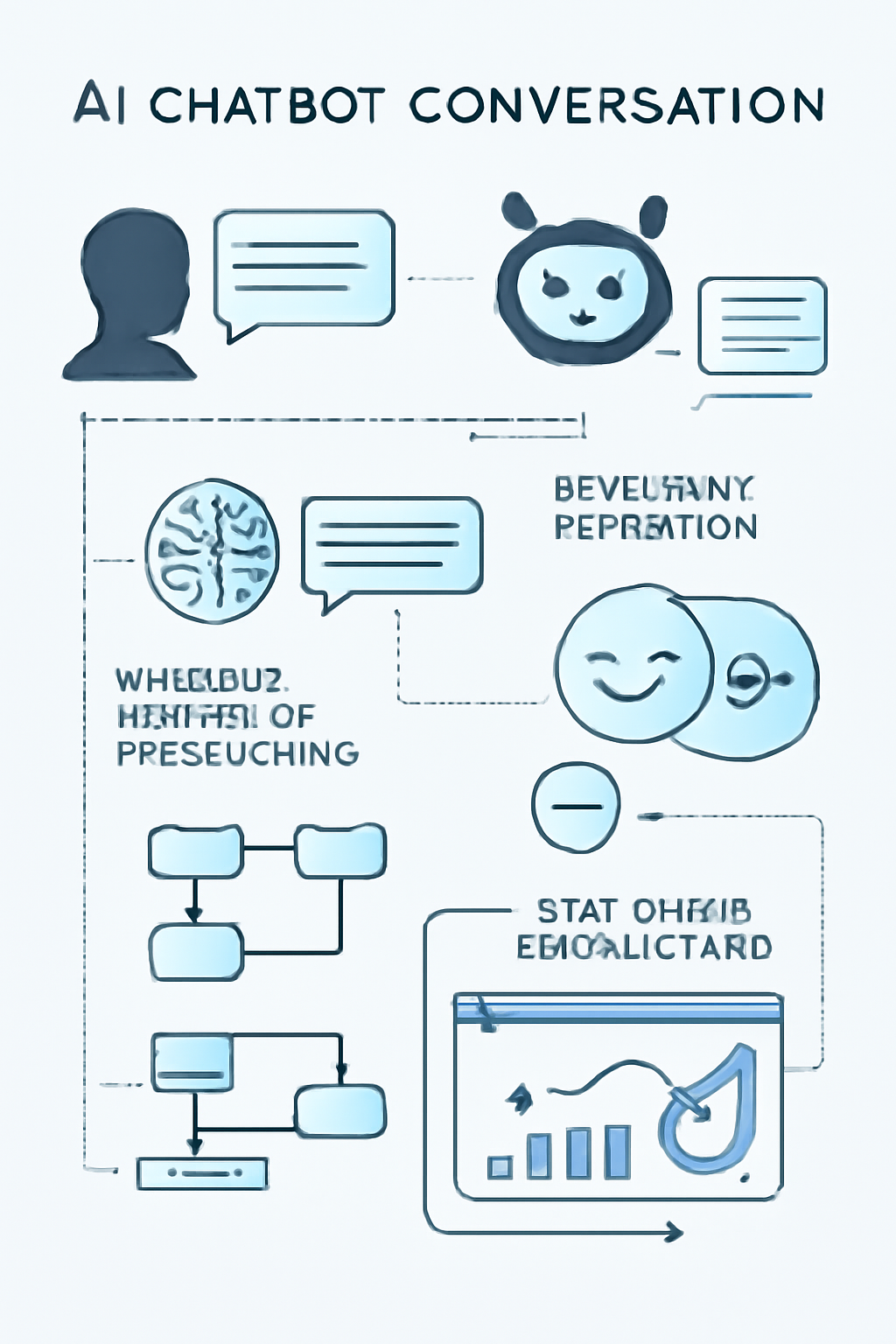
The impact on response times is dramatic. While traditional customer service might take hours or days to respond to email inquiries, AI chatbots provide instant answers to common questions, reducing average resolution times from 38 hours to under 5 minutes for routine issues. This immediacy directly correlates with customer satisfaction—research shows that 82% of customers expect immediate responses to sales and service questions.
Advanced chatbot implementations integrate with backend systems to perform actions beyond answering questions. They can process returns, update account information, schedule appointments, track orders, and even complete purchases—all through natural conversation. This functional capability transforms chatbots from information providers into full-service digital assistants that handle end-to-end customer needs.
Natural Language Processing for Deeper Understanding
Natural language processing (NLP) powers the intelligence behind conversational AI, enabling systems to understand not just keywords but the meaning, intent, and emotion behind customer communications. NLP algorithms parse sentence structure, identify entities, extract intent, and determine sentiment—allowing AI systems to respond appropriately to nuanced customer requests.
In customer support applications, NLP automates ticket routing by analyzing incoming requests and directing them to the appropriate department or specialist. This eliminates the frustration of customers being transferred multiple times and reduces resolution times by 35-50%. More sophisticated implementations use NLP to extract structured data from unstructured customer feedback, identifying recurring issues, feature requests, and pain points across thousands of interactions.
Sentiment Analysis and Emotional Intelligence
Understanding customer emotions in real-time represents one of AI’s most powerful contributions to customer experience. Sentiment analysis algorithms evaluate text, voice tone, and even facial expressions to gauge customer emotional states during interactions. This emotional intelligence enables AI systems to adapt their responses, escalate frustrated customers to human agents, or flag at-risk accounts for proactive outreach.
Real-time sentiment monitoring transforms customer service from reactive to proactive. When AI detects negative sentiment patterns—such as repeated frustration indicators or dissatisfaction signals—it can trigger immediate interventions. Customer service managers receive alerts about deteriorating situations while they’re still recoverable, rather than discovering problems through post-interaction surveys when it’s too late to prevent churn.
Beyond individual interactions, aggregate sentiment analysis provides strategic insights into customer perception trends. Organizations can track sentiment across products, features, channels, and time periods to identify systemic issues, measure the impact of changes, and benchmark performance against competitors. This data-driven emotional intelligence informs everything from product development to marketing messaging.
Personalization Engines and Individualized Experiences
AI-powered personalization engines represent the technology that enables businesses to treat each customer as an individual, even when serving millions. These systems analyze behavioral data, purchase history, preferences, browsing patterns, and contextual signals to deliver tailored content, recommendations, and experiences to each customer in real-time.
The scale at which AI enables personalization is unprecedented. While human agents might personalize interactions for high-value customers, AI personalizes every touchpoint for every customer simultaneously. Netflix’s recommendation engine, Amazon’s product suggestions, and Spotify’s personalized playlists demonstrate how AI personalization drives engagement and loyalty at massive scale.
In customer service contexts, personalization manifests through contextual assistance that remembers previous interactions, anticipates needs based on customer history, and proactively offers relevant solutions. When a customer contacts support, AI systems immediately surface their account history, previous issues, product ownership, and likely reason for contact—enabling faster, more relevant assistance whether delivered by AI or human agents.
Predictive Analytics for Anticipatory Service
Predictive analytics elevates customer experience from responsive to anticipatory by forecasting customer needs, behaviors, and potential issues before they occur. Machine learning models analyze historical patterns to predict which customers are likely to churn, which products a customer will need next, when equipment might fail, or what questions customers will ask.
This predictive capability enables proactive customer service strategies. Instead of waiting for customers to report problems, AI identifies early warning signs and triggers preventive interventions. Telecommunications companies use predictive models to identify network issues affecting specific customers and resolve them before customers experience service disruptions. E-commerce platforms predict when customers will run out of consumable products and send timely reorder reminders.
Churn prediction models specifically help organizations identify at-risk customers weeks or months before they defect, enabling targeted retention campaigns. By analyzing engagement patterns, support interaction frequency, product usage decline, and sentiment trends, AI assigns churn probability scores to individual customers. This allows customer success teams to prioritize outreach to those most likely to leave, often recovering 20-30% of at-risk accounts through timely intervention.
Voice AI and Intelligent Call Centers
AI voice assistants are revolutionizing phone-based customer service by providing natural, conversational interactions that rival human agents for routine inquiries. Unlike traditional IVR systems with frustrating menu trees, conversational AI allows customers to describe their needs in natural language and receive immediate, relevant assistance.
Modern voice AI systems understand context, handle interruptions, ask clarifying questions, and maintain conversation flow across complex interactions. They integrate with business systems to authenticate customers through voice biometrics, access account information, process transactions, and update records—all while maintaining natural conversation. This creates experiences that feel personal and efficient rather than robotic and constraining.
The business case for voice AI is compelling. AI voice assistants handle unlimited simultaneous calls, eliminate hold times for routine inquiries, operate 24/7 without staffing costs, and consistently deliver accurate information. Organizations implementing voice AI report 40-60% reductions in call center costs while maintaining or improving customer satisfaction scores. Human agents are freed to handle complex cases requiring empathy, negotiation, or creative problem-solving—work that AI cannot yet replicate.
Customer Journey Mapping and Optimization
AI-driven customer journey mapping provides unprecedented visibility into how customers interact with your organization across all touchpoints. By analyzing data from websites, mobile apps, customer service interactions, purchases, and engagement metrics, AI constructs detailed journey maps showing actual customer paths rather than assumed ones.
These AI-generated journey maps reveal friction points, abandonment triggers, and optimization opportunities that would be invisible in traditional analysis. Machine learning algorithms identify patterns showing where customers get stuck, which sequences lead to conversions, and how different segments navigate differently. This insight enables targeted improvements to specific journey stages, dramatically increasing conversion rates and satisfaction.
Continuous journey optimization represents AI’s ongoing contribution. Rather than static journey maps created quarterly or annually, AI provides real-time journey intelligence that adapts to changing customer behaviors. As new patterns emerge or existing paths shift, AI alerts experience teams to investigate and respond, ensuring journey optimization remains current and effective.
Computer Vision for Visual Support
Computer vision AI extends customer experience capabilities into visual domains, enabling applications like visual search, product recognition, and image-based troubleshooting. Customers can photograph products to find purchasing information, submit images of problems for automated diagnosis, or use augmented reality to visualize products in their environment before buying.
In technical support contexts, computer vision dramatically improves troubleshooting efficiency. Customers upload photos of error messages, damaged products, or installation challenges, and AI analyzes the images to identify issues and suggest solutions. This visual problem-solving reduces the need for lengthy verbal descriptions and accelerates resolution, particularly for hardware, installation, and physical product issues.
Implementation Strategy and Best Practices
Successfully implementing AI-powered customer experience requires strategic planning, phased rollout, and continuous optimization. Organizations should begin by identifying high-impact, low-complexity use cases—typically routine inquiries that consume significant agent time but require straightforward responses. Early wins build organizational confidence and provide learning opportunities before tackling more complex applications.
Data quality and integration represent the most common implementation challenges. AI systems require clean, comprehensive, integrated data to function effectively. Organizations must invest in data consolidation, cleaning legacy data, establishing data governance, and creating real-time integration between AI systems and existing platforms. This foundational work determines AI effectiveness more than algorithm sophistication.
Human-AI collaboration models deliver superior results compared to fully automated approaches. The most effective implementations use AI to handle routine tasks, gather information, and provide recommendations, while keeping humans in the loop for complex decisions, emotional situations, and relationship-building. This hybrid model combines AI’s efficiency and consistency with human empathy and creativity, delivering experiences that satisfy both efficiency and emotional needs.
Continuous monitoring and optimization ensure AI systems improve over time rather than stagnate. Organizations should establish feedback loops that capture when AI responses miss the mark, track performance metrics across customer segments, and regularly retrain models with new data. AI customer experience is not a set-and-forget implementation but an evolving capability that requires ongoing attention and refinement.
Measuring AI CX Success and ROI
Quantifying the impact of AI-powered customer experience requires tracking both operational metrics and customer outcome measures. Key performance indicators include automation rate (percentage of inquiries handled without human intervention), average resolution time, first-contact resolution rate, customer satisfaction scores, Net Promoter Score, and customer effort score. These metrics should be tracked before and after AI implementation to demonstrate impact.
Financial ROI calculations should account for direct cost savings from reduced agent headcount or overtime, increased revenue from improved conversion rates and reduced churn, and efficiency gains from faster resolution times. Most organizations achieve positive ROI within 12-18 months, with ongoing returns increasing as AI systems learn and expand to additional use cases.
Qualitative feedback provides essential context beyond quantitative metrics. Customer interviews, sentiment analysis of feedback, and agent testimonials reveal how AI impacts experience quality, where gaps remain, and what improvements would deliver the greatest value. This qualitative insight guides prioritization and ensures AI enhancements align with actual customer and agent needs.
The Future of AI-Powered Customer Experience
The evolution of AI-powered customer experience continues accelerating as technologies mature and new capabilities emerge. Emerging trends include hyper-personalization using real-time behavioral signals, emotion AI that responds to subtle emotional cues, multimodal AI that seamlessly integrates text, voice, and visual interactions, and autonomous AI agents that handle complex multi-step processes without human oversight.
Generative AI represents the next frontier, enabling AI systems to create personalized content, generate custom solutions, and engage in more natural, contextually rich conversations. These systems move beyond selecting from predefined responses to generating unique, situation-specific answers that feel genuinely personalized and relevant.
As AI capabilities expand, the competitive imperative intensifies. Customer expectations continue rising, shaped by best-in-class experiences from AI leaders. Organizations that delay AI adoption risk falling behind not just in efficiency but in their ability to meet basic customer expectations for instant, personalized, proactive service. AI-powered customer experience has transitioned from competitive advantage to competitive necessity—the question is no longer whether to implement AI, but how quickly and effectively you can deploy it to transform your customer experience.
Frequently Asked Questions
What is AI-powered customer experience and how does it work?
AI-powered customer experience uses artificial intelligence technologies like machine learning, natural language processing, and predictive analytics to automate, personalize, and optimize customer interactions. It works by analyzing customer data in real-time to deliver personalized responses, predict needs, and continuously improve service quality through learning algorithms.
How much can AI improve customer service response times?
AI can reduce customer service response times by 60-80% through instant chatbot responses and automated ticket routing. Many organizations report reducing average response times from hours to seconds for common queries, while AI handles up to 80% of routine customer inquiries without human intervention.
What are the main benefits of implementing AI in customer experience?
The main benefits include 24/7 availability, instant response times, personalized interactions at scale, reduced operational costs (up to 30%), improved customer satisfaction scores, predictive issue resolution, and data-driven insights. AI also frees human agents to handle complex issues requiring empathy and creative problem-solving.
Is AI customer service expensive to implement?
Implementation costs vary widely from $10,000 for basic chatbots to $500,000+ for enterprise solutions, but ROI typically appears within 6-18 months. Cloud-based AI platforms and SaaS solutions have significantly reduced entry barriers, with many scalable options starting under $100/month for small businesses.
Will AI replace human customer service agents?
AI augments rather than replaces human agents by handling routine queries and administrative tasks, allowing humans to focus on complex, emotional, or nuanced situations. The most effective customer experience strategies combine AI efficiency with human empathy, creating hybrid models that leverage the strengths of both.