Table of Contents
- The Fundamental ROI Formula for AI Implementation
- Essential Metrics for Measuring AI Implementation Success
- Step-by-Step Process to Calculate Your AI ROI
- Real Business Examples of AI ROI Calculations
- Common Pitfalls in AI ROI Calculations and How to Avoid Them
- Advanced Considerations for Comprehensive AI ROI Analysis
- Optimizing Your AI ROI Over Time
- Frequently Asked Questions
Understanding how to calculate ROI on AI implementation is critical for business leaders seeking to justify their technology investments and measure actual value delivered. While artificial intelligence promises transformative benefits, quantifying those benefits in financial terms requires a systematic approach to measurement, clear metrics, and realistic timeframes. This comprehensive guide provides the formulas, methodologies, and real-world examples you need to accurately assess your AI investment returns and make data-driven decisions about future AI initiatives.
The Fundamental ROI Formula for AI Implementation
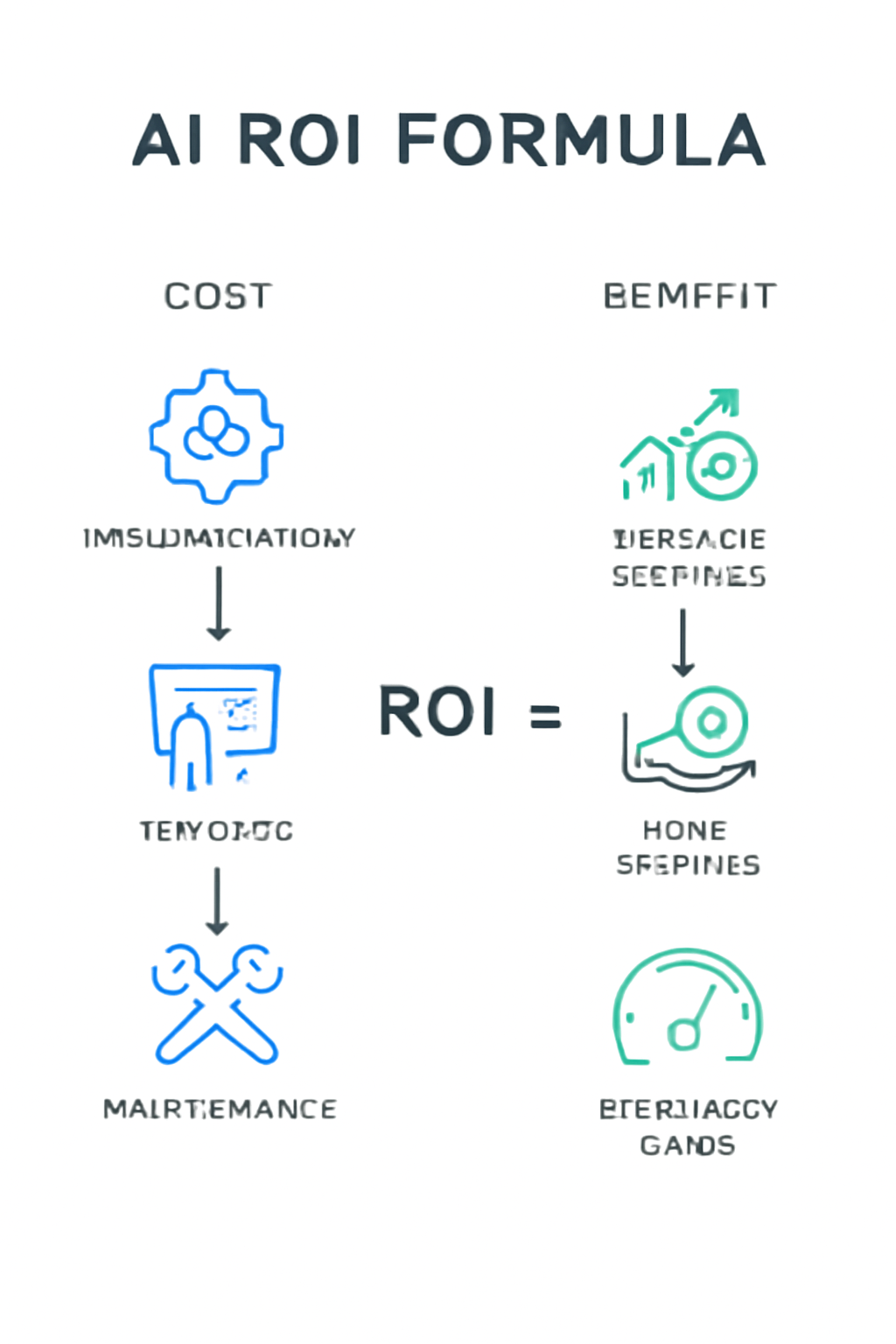
The basic ROI calculation for AI projects follows the standard investment return formula, but requires careful consideration of both tangible and intangible benefits. The core formula is: ROI = (Net Benefit / Total Cost of Investment) × 100. Net benefit equals the total gains from AI implementation minus the total costs, while total cost includes all expenses from planning through ongoing operations.
For AI specifically, this calculation becomes more nuanced. Your total costs must encompass initial software or platform licensing, implementation and integration expenses, data preparation and cleaning, employee training, change management, and ongoing maintenance. The benefits side includes direct cost savings, revenue increases, productivity improvements, error reduction, and enhanced customer experiences that translate to financial value.
A more detailed AI ROI formula looks like this: AI ROI = [(Revenue Increase + Cost Savings + Productivity Gains) – (Implementation Costs + Operational Costs + Training Costs)] / (Implementation Costs + Operational Costs + Training Costs) × 100. This expanded version ensures you capture the full financial picture of your AI investment over a specific time period, typically measured annually or over a three-year horizon.
Essential Metrics for Measuring AI Implementation Success
To calculate ROI on AI implementation accurately, you need to track specific metrics before and after deployment. Productivity metrics include processing time per transaction, tasks completed per employee per day, and throughput volume. For a customer service AI, you might measure tickets resolved per hour, average handle time, and first-contact resolution rates.
Cost reduction metrics focus on quantifiable savings. Track labor cost reductions from automation, decreased error rates and associated correction costs, reduced infrastructure expenses, lower customer acquisition costs, and diminished operational overhead. A manufacturing AI might measure defect rates, waste reduction, energy consumption, and downtime minutes prevented.
Revenue impact metrics capture the top-line growth attributable to AI. These include increased sales conversion rates, higher average order values, improved customer retention and lifetime value, new revenue streams enabled by AI capabilities, and market share gains. An e-commerce recommendation engine, for example, would track incremental revenue from AI-suggested purchases and repeat purchase rates.
Quality and accuracy metrics provide supporting evidence for ROI claims. Monitor prediction accuracy rates, error reduction percentages, customer satisfaction scores, Net Promoter Score changes, and compliance improvement metrics. These quality indicators often correlate directly with financial outcomes and help validate your ROI calculations.

Step-by-Step Process to Calculate Your AI ROI
Begin by establishing your baseline measurements before AI implementation. Document current performance across all relevant metrics, including costs, productivity levels, error rates, and revenue figures. This baseline provides the comparison point for measuring improvement and calculating actual returns. Collect at least three months of pre-implementation data to account for normal business fluctuations.
Next, calculate your total AI implementation costs comprehensively. Include software licensing fees, hardware or cloud infrastructure costs, vendor implementation services, internal IT and development resources, data preparation expenses, employee training programs, change management initiatives, and consulting fees. Don’t overlook hidden costs like temporary productivity dips during transition or ongoing subscription fees.
Project your ongoing operational costs over your measurement period. Factor in annual software maintenance and updates, cloud computing or infrastructure costs, dedicated staff for AI system management, model retraining and improvement cycles, data storage and processing expenses, and technical support. These recurring costs significantly impact long-term ROI and are often underestimated in initial projections.
Measure and quantify your benefits systematically. After implementation, track the same metrics you baselined, measuring improvements monthly. Convert productivity gains to dollar values using average salary costs. Calculate cost savings from reduced errors, lower staffing needs, or decreased infrastructure. Measure revenue increases from improved conversion, retention, or new AI-enabled offerings. Assign conservative monetary values to ensure credible ROI claims.
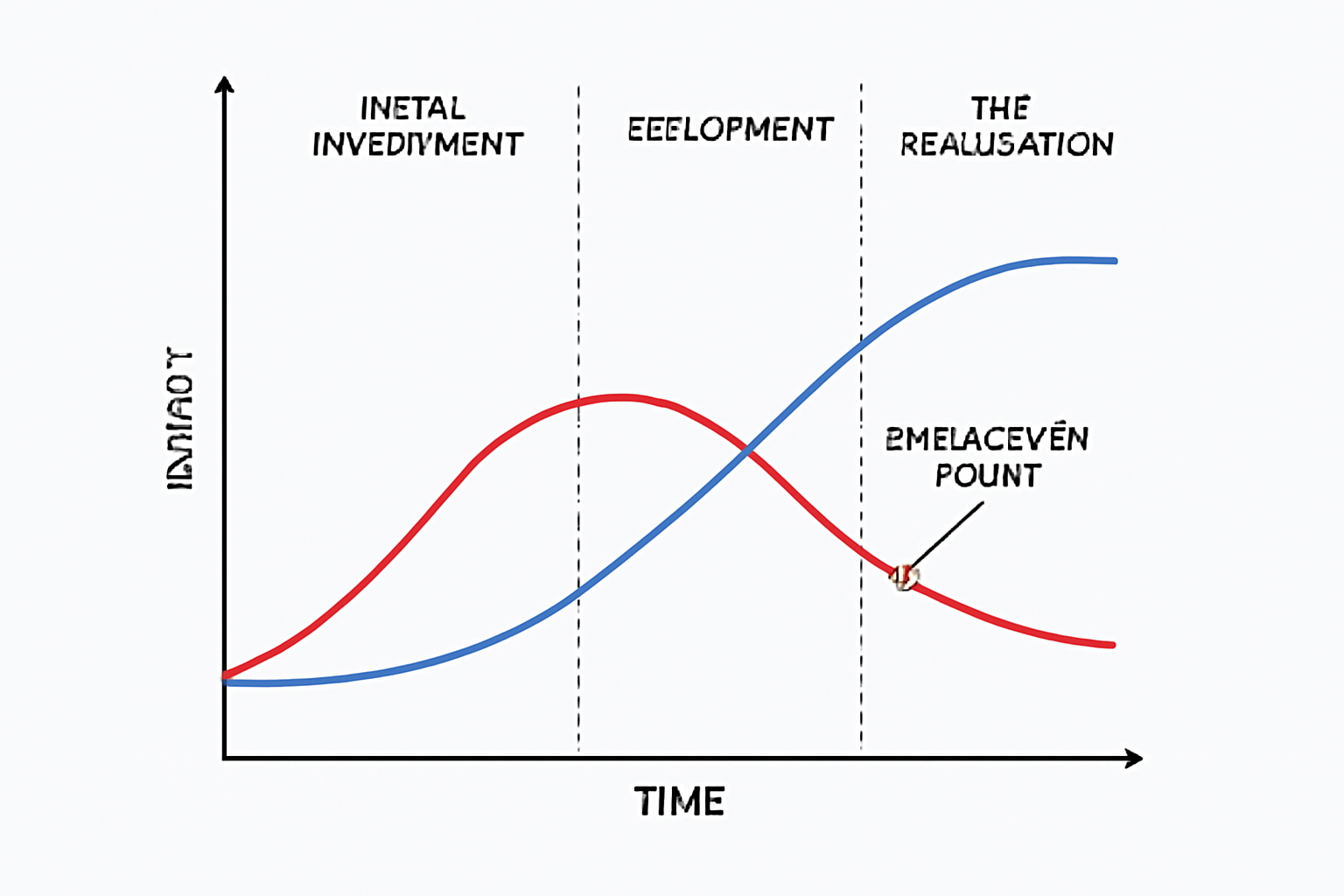
Apply the ROI formula using your actual data. For example, if your AI implementation cost $500,000 with $150,000 in annual operational costs, and delivers $300,000 in annual cost savings plus $250,000 in additional revenue, your first-year ROI calculation would be: [($300,000 + $250,000) – $650,000] / $650,000 × 100 = -15.4%. This negative first-year return is common, with positive ROI emerging in year two as implementation costs are absorbed and benefits compound.
Real Business Examples of AI ROI Calculations
A mid-sized insurance company implemented an AI-powered claims processing system at a total cost of $750,000, including $250,000 in annual operational expenses. The system reduced claims processing time by 60%, allowing the company to handle 40% more claims with the same staff, eliminate $180,000 in annual overtime costs, and reduce claim errors by 75%, saving $220,000 annually in correction costs and fraud losses. Additional benefits included $150,000 in improved customer retention due to faster claim resolution. Their first-year ROI: [($180,000 + $220,000 + $150,000) – $1,000,000] / $1,000,000 × 100 = -45%. By year three, with cumulative benefits of $1,650,000 against total costs of $1,500,000, they achieved a positive 10% ROI that continued improving annually.
An e-commerce retailer deployed an AI recommendation engine for $200,000 with $50,000 annual maintenance costs. The system increased average order value by 18% and conversion rates by 12%, generating an additional $1.2 million in first-year revenue. Implementation and first-year operational costs totaled $250,000, yielding a remarkable first-year ROI of 380%. This example demonstrates how customer-facing AI applications with direct revenue impact can deliver faster, more dramatic returns than operational efficiency projects.
A manufacturing company invested $1.2 million in predictive maintenance AI with $300,000 in annual costs. The system reduced unplanned downtime by 45%, saving $600,000 annually in lost production, decreased maintenance costs by $250,000 through optimized scheduling, and extended equipment life by 20%, deferring $400,000 in capital expenditures. First-year ROI: [($600,000 + $250,000 + $400,000) – $1,500,000] / $1,500,000 × 100 = -16.7%. However, the three-year cumulative ROI reached 150%, with benefits accelerating as the AI system’s predictive accuracy improved with more operational data.
Common Pitfalls in AI ROI Calculations and How to Avoid Them
Many organizations underestimate implementation timelines and costs, leading to inflated ROI projections. Avoid this by adding a 30-40% buffer to vendor estimates and extending your expected implementation timeline by at least 25%. AI projects frequently encounter data quality issues, integration challenges, and adoption hurdles that extend timelines and increase costs beyond initial projections.
Another critical mistake is failing to account for the full cost of ownership. Organizations often calculate ROI based solely on software licensing costs while overlooking data preparation expenses, integration complexity, ongoing model maintenance, and the staff time required for AI system management. Create a comprehensive cost inventory that includes every resource touched by the AI implementation, from data engineers to change management consultants.
Attributing all improvements solely to AI without controlling for other variables inflates ROI calculations. If you implement AI alongside process improvements, new training programs, or market expansion, isolate the AI-specific impact through controlled comparisons or phased rollouts. Use A/B testing where possible, comparing AI-enabled processes against traditional methods operating simultaneously.
Measuring ROI too early produces misleading results. AI systems typically require 6-12 months to reach optimal performance as models learn from production data and users become proficient. Establish measurement checkpoints at 6, 12, 24, and 36 months to track ROI evolution. Report interim results transparently while emphasizing the long-term value trajectory rather than premature snapshots.

Advanced Considerations for Comprehensive AI ROI Analysis
Beyond basic ROI calculations, sophisticated analyses incorporate time value of money through net present value (NPV) and internal rate of return (IRR) calculations. These methods discount future benefits to present value, providing a more accurate picture of investment returns. For AI projects with benefits extending over many years, NPV calculations using your organization’s cost of capital provide better decision-making data than simple ROI percentages.
Risk-adjusted ROI accounts for implementation uncertainty and potential failure scenarios. Assign probability weights to different outcome scenarios—optimistic, expected, and pessimistic—to calculate expected ROI. This approach acknowledges that AI projects carry higher uncertainty than traditional IT investments and helps set realistic expectations with stakeholders while identifying risk mitigation strategies.
Consider opportunity costs in your analysis. The resources invested in AI could alternatively fund other initiatives with different return profiles. Compare your AI ROI against alternative investments, including traditional process improvements, additional staff, or other technology solutions. This comparative analysis ensures AI represents the best use of limited capital and resources.
Factor in strategic value beyond immediate financial returns. AI implementations often create platform capabilities enabling future innovations, competitive advantages difficult to quantify financially, improved organizational learning and data literacy, and enhanced ability to attract top talent. While these benefits resist precise ROI calculation, documenting them provides context for investment decisions and helps justify projects with longer payback periods but substantial strategic value.
Optimizing Your AI ROI Over Time
AI ROI improves significantly after initial implementation as you optimize systems and expand applications. Continuously refine models with production data to improve accuracy and efficiency. Expand successful AI applications to additional use cases, departments, or customer segments to leverage fixed implementation costs across broader benefit pools. A chatbot initially deployed for customer service can extend to sales support, HR inquiries, and technical troubleshooting, multiplying returns on the core platform investment.
Establish a regular ROI review cadence, measuring quarterly and reporting annually. Track how actual results compare to projections, identifying variances and their causes. Use these insights to improve future AI project estimates and refine your implementation methodology. Organizations that systematically measure and optimize AI ROI achieve 40-60% better returns than those treating implementation as a one-time project rather than an ongoing optimization process.
Document and share ROI results across your organization to build AI literacy and support for future initiatives. Transparent reporting of both successes and challenges builds credibility, helps secure funding for expansion, and creates realistic expectations for new projects. Case studies from your own AI implementations provide the most compelling evidence for additional investment and help other departments learn from your experience to accelerate their own AI adoption and ROI realization.
Frequently Asked Questions
What is a good ROI percentage for AI implementation?
A good ROI for AI implementation typically ranges from 200% to 400% over three years, though this varies significantly by industry and use case. Enterprise AI projects often target a minimum 150% ROI to justify the investment, while some automation projects can achieve 500% or higher returns through substantial cost savings and efficiency gains.
How long does it take to see ROI from AI implementation?
Most AI implementations begin showing measurable ROI within 6 to 18 months, with the timeline depending on project complexity and scope. Simple automation projects may deliver returns in 3-6 months, while complex machine learning systems requiring extensive training data and integration may take 18-24 months to reach full ROI potential.
What are the hidden costs that affect AI ROI calculations?
Hidden costs that impact AI ROI include ongoing data quality maintenance, model retraining and updates, change management and employee training, integration with legacy systems, and dedicated staff for AI system monitoring. These operational expenses can add 30-50% to initial implementation costs and must be factored into accurate ROI calculations.
How do you measure intangible benefits in AI ROI calculations?
Intangible AI benefits can be quantified by assigning monetary values to improvements like customer satisfaction scores, employee retention rates, brand reputation metrics, and competitive advantages. Methods include comparing customer lifetime value changes, calculating recruitment cost savings from improved retention, and measuring market share gains attributable to AI-enhanced capabilities.
What metrics should be tracked to calculate AI implementation ROI accurately?
Essential metrics for AI ROI calculations include total cost of ownership (implementation, training, maintenance), productivity improvements (time saved, output increased), cost reductions (labor, errors, operational expenses), revenue impact (new sales, customer retention), and quality improvements (accuracy rates, defect reduction). Tracking these metrics before and after implementation provides the data needed for accurate ROI calculation.