Understanding how to calculate ROI on AI implementation is critical for securing stakeholder buy-in and measuring the true business impact of artificial intelligence investments. While AI promises transformative benefits, quantifying these returns requires a structured approach that accounts for both direct costs and multifaceted value creation. This comprehensive guide provides the financial frameworks, formulas, and methodologies you need to accurately measure and communicate the return on your AI initiatives.
Understanding the Fundamentals of AI ROI Calculation
Calculating ROI on AI implementation differs from traditional technology investments due to AI’s unique characteristics. Unlike conventional software deployments with predictable outcomes, AI systems improve over time, generate compound benefits, and often deliver value across multiple business functions simultaneously.
The basic ROI formula remains foundational: ROI = (Net Benefit / Total Cost) × 100. However, applying this to AI requires careful consideration of what constitutes “net benefit” and “total cost” in the context of machine learning systems, data infrastructure, and ongoing optimization.
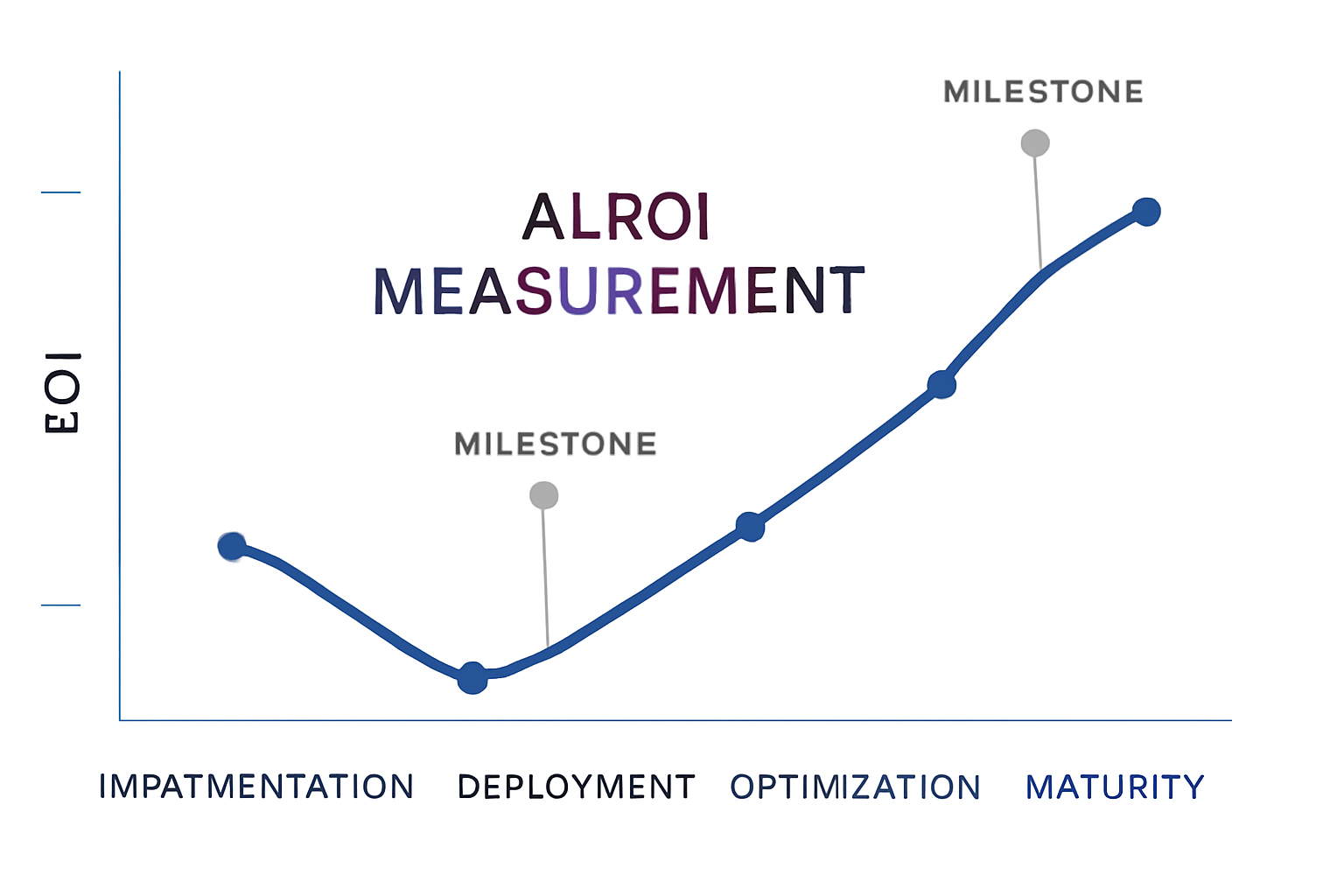
AI investments typically span 18-36 months before reaching full maturity, meaning your calculation methodology must account for time-value of money, phased implementations, and evolving benefits that emerge as systems learn and improve.
Identifying and Quantifying AI Implementation Costs
Accurate ROI calculation begins with comprehensive cost accounting. AI implementation costs fall into several distinct categories that must all be captured in your financial model.
Initial Investment Costs
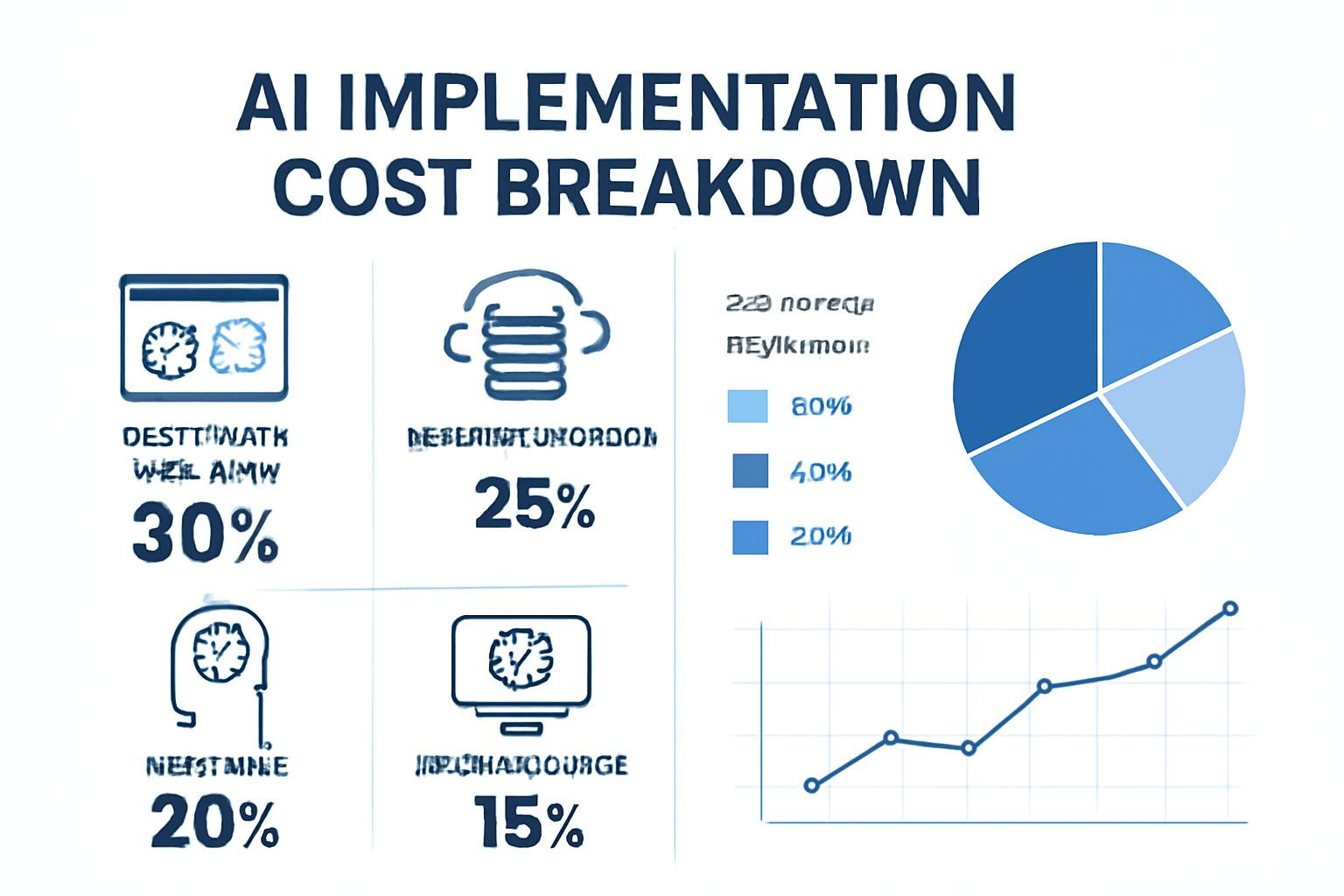
Your upfront costs include software licensing or development expenses, which can range from $50,000 for off-the-shelf solutions to millions for custom enterprise AI platforms. Infrastructure costs encompass cloud computing resources, GPU processing power, and data storage—often representing 20-30% of total project budgets.
Don’t overlook data preparation costs, which frequently consume 40-60% of initial project timelines. This includes data cleaning, labeling, integration, and establishing governance frameworks necessary for AI model training.
Ongoing Operational Expenses
Monthly operational costs include cloud computing fees, API calls, model monitoring tools, and data pipeline maintenance. For most organizations, these recurring expenses represent $5,000-$50,000 monthly depending on scale and complexity.
Personnel costs deserve special attention. You’ll need data scientists, ML engineers, and business analysts during implementation, plus ongoing support staff. Factor in both direct salaries and the opportunity cost of diverting existing team members from other initiatives.
Hidden and Indirect Costs
Change management and training programs often represent 15-25% of total implementation costs but are frequently underestimated. Include expenses for employee training, process redesign, and productivity dips during transition periods.
Integration costs with existing systems, compliance and security measures, and contingency buffers for unexpected challenges should add another 10-20% to your cost projections.
Measuring and Calculating AI Benefits
The benefits side of your ROI equation requires equal rigor. AI creates value through multiple channels, each requiring specific measurement approaches.

Direct Cost Savings
Automation-driven labor savings are often the most straightforward to quantify. Calculate the hours saved multiplied by loaded labor rates. For example, if AI automation eliminates 2,000 hours of manual data entry monthly at a loaded rate of $35/hour, that’s $70,000 in monthly savings or $840,000 annually.
Process efficiency improvements can be measured through reduced processing time, lower error rates, and decreased rework. If AI reduces order processing time from 48 hours to 6 hours, quantify the value of that 42-hour improvement across your transaction volume.
Revenue Enhancement
AI-powered personalization, recommendation engines, and predictive analytics often drive revenue growth. Measure incremental revenue by comparing conversion rates, average order values, and customer lifetime value before and after AI implementation.
For a retail organization, if AI recommendations increase average order value by 12% across 50,000 monthly transactions with a $75 baseline, that’s $450,000 in additional monthly revenue directly attributable to AI.
Risk Reduction and Avoidance
Quantify fraud prevention savings by calculating detected fraud amounts and comparing false positive rates. If AI fraud detection prevents $2 million in annual fraud losses while reducing false positives by 60%, both figures contribute to your ROI calculation.
Compliance and risk mitigation benefits can be valued using the cost of violations avoided, insurance premium reductions, and decreased legal exposure.
The Complete AI ROI Calculation Framework
With costs and benefits identified, apply this structured framework to calculate comprehensive AI ROI.
Step 1: Calculate Total Cost of Ownership (TCO)
Sum all costs over your evaluation period (typically 3-5 years): TCO = Initial Investment + (Annual Operational Costs × Number of Years) + Hidden Costs. For example: $500,000 initial + ($200,000 × 3 years) + $150,000 hidden costs = $1,250,000 total investment.
Step 2: Project Total Benefits
Aggregate all quantified benefits over the same timeframe: Total Benefits = Annual Cost Savings + Revenue Increases + Risk Avoidance. Using our earlier examples: ($840,000 + $5,400,000 + $2,000,000) × 3 years = $24,720,000 in total benefits.
Step 3: Calculate Net Present Value (NPV)
Apply discounting to account for time-value of money. Using a 10% discount rate: NPV = Σ (Benefit_year / (1 + 0.10)^year) – TCO. This provides a more accurate picture than simple ROI by recognizing that future dollars are worth less than present dollars.
Step 4: Determine ROI Percentage and Payback Period
Calculate standard ROI: ((Total Benefits – TCO) / TCO) × 100. In our example: (($24,720,000 – $1,250,000) / $1,250,000) × 100 = 1,878% ROI over three years.
Determine payback period by calculating when cumulative benefits exceed cumulative costs. Many successful AI implementations achieve payback within 12-24 months.
Accounting for Intangible Benefits
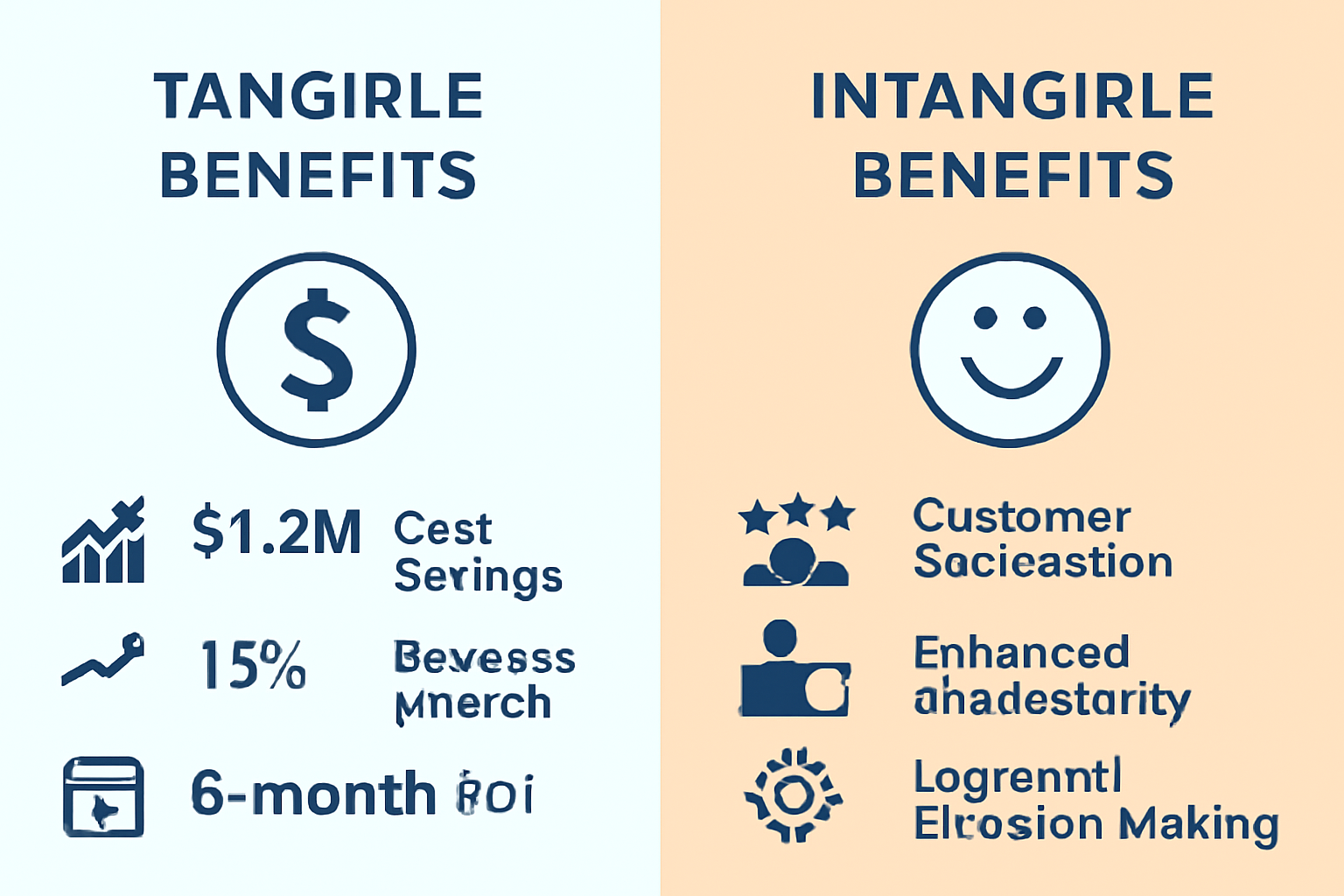
Not all AI value translates easily into financial metrics, yet these intangible benefits significantly impact long-term success and should be documented alongside quantitative ROI.
Customer Experience Improvements
Enhanced customer satisfaction, reduced wait times, and personalized interactions create competitive advantages. While challenging to quantify precisely, proxy metrics like Net Promoter Score improvements and customer retention rate increases provide supporting evidence of value creation.
Employee Productivity and Satisfaction
AI tools that eliminate tedious tasks improve employee satisfaction and reduce turnover. Calculate the cost of employee replacement (typically 50-200% of annual salary) and apply retention improvements to estimate this benefit.
Strategic Capabilities
AI implementation builds organizational capabilities in data science, machine learning, and analytics that enable future innovations. This platform value compounds over time as additional use cases leverage existing infrastructure and expertise.
Common Pitfalls in AI ROI Calculation
Avoid these frequent mistakes that lead to inaccurate ROI projections and disappointed stakeholders.
Overestimating early benefits is perhaps the most common error. AI systems require training periods and optimization cycles before reaching peak performance. Build realistic ramp-up assumptions into your models, typically assuming 40-60% of full benefits in year one, 80-90% in year two, and full benefits by year three.
Underestimating data preparation and change management costs leads to budget overruns that destroy projected ROI. Add 25-30% contingency buffers to initial estimates for these frequently underscoped activities.
Failing to account for cannibalization effects can inflate revenue benefit calculations. If AI-driven recommendations shift sales from one product to another rather than creating net new revenue, your ROI calculation should reflect only the margin improvement, not total revenue.
Ignoring opportunity costs of team time and resources diverted from other projects creates incomplete financial pictures. Include the value of alternative uses for capital and human resources in your analysis.
Tracking and Reporting AI ROI Over Time
ROI calculation isn’t a one-time exercise but an ongoing measurement discipline that validates assumptions and guides optimization.
Establish baseline metrics before implementation across all benefit categories. Document current state performance in detail so you can accurately measure improvements and attribute them to AI initiatives.
Implement monitoring dashboards that track actual costs and benefits against projections monthly. Flag variances exceeding 10-15% for investigation and course correction.
Conduct quarterly ROI reviews with stakeholders, updating projections based on actual performance data. This builds credibility and enables evidence-based decisions about scaling, modifying, or terminating AI initiatives.
Create executive scorecards that present ROI alongside operational KPIs, showing both financial returns and business impact metrics. This balanced view demonstrates value while maintaining accountability for results.
Optimizing AI ROI Through Continuous Improvement
The most successful organizations treat AI ROI as a variable to be actively managed and improved rather than a fixed outcome to be measured.
Prioritize high-impact use cases that deliver measurable benefits quickly, building momentum and funding for more ambitious initiatives. Quick wins in the 3-6 month range generate cash flow that can fund longer-term strategic projects.
Continuously retrain and optimize models to improve accuracy and efficiency. A 5% improvement in model performance often translates to significant ROI increases when applied across thousands or millions of transactions.
Expand successful AI applications to additional use cases and business units, leveraging existing infrastructure and expertise. This economies of scale approach dramatically improves overall ROI as marginal costs of additional applications remain low.
By applying these rigorous calculation methodologies, avoiding common pitfalls, and maintaining ongoing measurement discipline, you can accurately calculate ROI on AI implementation and optimize returns throughout the AI lifecycle. This financial clarity transforms AI from an experimental technology into a strategic business investment with measurable, defensible returns.