In today’s rapidly evolving digital landscape, AI solutions for business have transitioned from experimental technology to essential competitive advantage. Organizations across industries are leveraging artificial intelligence to automate processes, enhance decision-making, and unlock unprecedented insights from their data. However, successful AI adoption requires more than purchasing the latest technology—it demands strategic planning, careful implementation, and ongoing optimization to deliver measurable returns on investment.
This comprehensive guide walks you through everything you need to know about implementing AI solutions in your organization, from calculating ROI and selecting the right vendors to overcoming integration challenges and establishing governance frameworks. Whether you’re a small business exploring your first AI project or an enterprise scaling AI across departments, this resource provides actionable insights to guide your journey.
Understanding AI Solutions for Business: Core Concepts and Applications
Artificial intelligence encompasses a broad range of technologies that enable machines to perform tasks traditionally requiring human intelligence. For businesses, this translates into practical applications including machine learning algorithms that identify patterns in data, natural language processing systems that understand customer inquiries, computer vision tools that analyze images and videos, and predictive analytics platforms that forecast future trends.
Modern AI solutions for business typically fall into several categories. Process automation AI handles repetitive tasks like data entry, invoice processing, and customer service responses. Analytical AI examines large datasets to uncover insights, predict outcomes, and support strategic decisions. Interactive AI powers chatbots, virtual assistants, and recommendation engines that enhance customer experiences. Generative AI creates new content, from marketing copy to product designs, accelerating creative workflows.
The most successful implementations combine multiple AI capabilities to address specific business challenges. A retail company might use computer vision to monitor inventory, machine learning to optimize pricing, and natural language processing to handle customer inquiries—all integrated into a cohesive system that drives efficiency and revenue growth.

Calculating ROI on AI Implementation: Metrics That Matter
Before investing in AI solutions, business leaders need clear frameworks for evaluating potential returns. AI ROI calculation differs from traditional technology investments because benefits often extend beyond direct cost savings to include improved decision quality, faster time-to-market, and enhanced customer satisfaction.
Start by establishing baseline metrics in areas where AI will be deployed. If implementing an AI-powered customer service system, measure current metrics like average handle time, resolution rates, customer satisfaction scores, and support staff costs. For predictive maintenance AI in manufacturing, track current downtime hours, maintenance costs, and equipment failure rates.
Quantifying Direct Financial Benefits
Direct financial benefits are the easiest to measure and include cost reductions from automation, increased revenue from better targeting or pricing, and savings from reduced errors or waste. Calculate these by multiplying the efficiency gain per transaction or process by the volume of transactions over a specific period. For example, if AI reduces invoice processing time from 15 minutes to 2 minutes, and you process 10,000 invoices monthly at a labor cost of $30 per hour, the monthly savings equal approximately $32,500.
Measuring Indirect and Strategic Value
Indirect benefits require more sophisticated measurement approaches. Improved decision-making quality might be quantified by tracking the success rate of decisions made with AI assistance versus without. Enhanced customer experience can be measured through Net Promoter Score improvements, customer lifetime value increases, or churn reduction. Faster innovation cycles might be evaluated by time-to-market metrics for new products or features.
A comprehensive ROI calculation should account for all implementation costs including software licenses, infrastructure, integration services, training, and ongoing maintenance, then compare these against both tangible and intangible benefits over a 3-5 year horizon. Many organizations find that AI investments break even within 18-24 months, with accelerating returns as systems mature and scale.
AI Solutions for Small Business: Accessible Entry Points
Small businesses often assume AI solutions require enterprise-level budgets and technical resources, but today’s market offers numerous accessible options. Cloud-based AI platforms with subscription pricing eliminate large upfront investments, while pre-trained models reduce the need for extensive data science expertise.
Small businesses should prioritize AI applications that address their most pressing pain points. Customer service chatbots can handle routine inquiries 24/7, freeing staff for complex interactions. AI-powered accounting tools automate bookkeeping and identify tax optimization opportunities. Marketing platforms use machine learning to optimize ad spending and target the right audiences. Inventory management systems predict demand patterns to reduce waste and stockouts.
The key for smaller organizations is starting with focused, high-impact use cases rather than attempting comprehensive AI transformation. Choose solutions with intuitive interfaces, strong vendor support, and proven track records in your industry. Many successful small business AI implementations begin with a single department or process, demonstrate value, then expand systematically to other areas.
Enterprise AI Integration: Overcoming Common Challenges
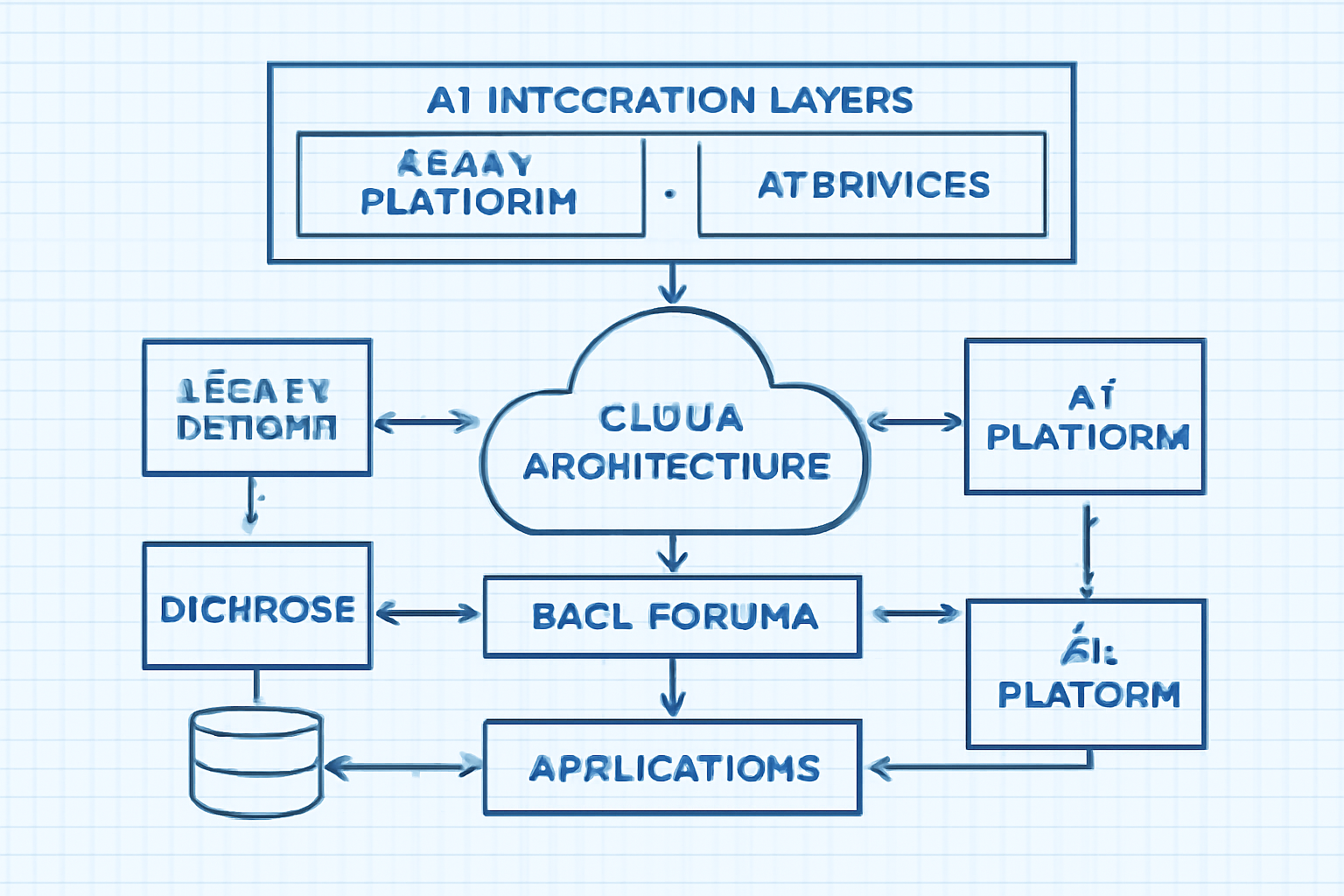
Large organizations face unique obstacles when implementing AI solutions at scale. Legacy systems that weren’t designed for AI integration, data scattered across disconnected silos, and organizational resistance to change represent the most common barriers to successful enterprise AI adoption.
Breaking Down Data Silos
AI systems require access to comprehensive, high-quality data, but many enterprises store information in isolated systems that don’t communicate effectively. Customer data might reside in CRM systems, transaction data in ERP platforms, and interaction data in marketing automation tools. Effective AI implementation requires establishing data integration layers that consolidate information while maintaining security and governance standards.
Modern data fabric architectures and API-driven integration platforms enable AI systems to access needed data without requiring complete system overhauls. Start by mapping your data landscape, identifying which datasets are critical for your AI use cases, and establishing secure data pipelines that feed AI platforms while respecting privacy regulations and access controls.
Modernizing Legacy Systems
Organizations don’t need to replace all legacy systems to implement AI solutions. Strategic approaches include building API wrappers around legacy applications to enable AI integration, implementing middleware platforms that translate between old and new systems, and using robotic process automation to bridge gaps where direct integration isn’t feasible.
The goal is creating an architecture where AI systems can access necessary data and execute actions without disrupting critical legacy operations. This hybrid approach allows organizations to gain AI benefits while gradually modernizing infrastructure on a manageable timeline.
Managing Organizational Change
Technical challenges often pale compared to human resistance. Employees fear job displacement, managers worry about losing control to algorithms, and executives question whether AI will deliver promised results. Successful change management requires transparent communication about AI’s role, comprehensive training programs, and involving employees in implementation processes.
Frame AI as augmenting human capabilities rather than replacing workers. Demonstrate how AI handles routine tasks so employees can focus on higher-value activities requiring creativity, empathy, and strategic thinking. Establish AI champions within departments who can advocate for adoption and support colleagues through transitions.
Selecting the Right AI Vendor: Evaluation Framework
The AI vendor landscape includes everything from specialized startups offering point solutions to comprehensive platforms from major technology companies. Choosing the right partner significantly impacts implementation success, ongoing costs, and long-term scalability.

Technical Capabilities Assessment
Evaluate vendors on their AI technology maturity, including the sophistication of their algorithms, the breadth of pre-built models, and their ability to customize solutions for your specific needs. Request technical demonstrations using your actual data (under appropriate confidentiality agreements) to assess real-world performance rather than relying on generic showcases.
Consider integration capabilities with your existing technology stack. Does the vendor provide robust APIs? Do they support the data formats and protocols your systems use? Can their solutions deploy in your preferred environment—cloud, on-premises, or hybrid?
Business Considerations
Beyond technology, assess the vendor’s business stability, industry expertise, and customer support quality. Review case studies from similar organizations, check customer references, and evaluate their implementation methodology. Understand their pricing model completely, including costs for additional users, data volume increases, and premium features.
Examine the vendor’s product roadmap and innovation track record. AI technology evolves rapidly, and you need a partner committed to continuous improvement. Ask about their approach to model updates, new feature releases, and how they help customers leverage emerging AI capabilities.
Security, Compliance, and Governance
AI vendors must demonstrate robust security practices, especially when handling sensitive business or customer data. Verify their compliance certifications relevant to your industry (HIPAA for healthcare, PCI DSS for payment processing, SOC 2 for data security). Understand where data is stored, how it’s encrypted, and who has access.
Review their AI ethics policies and transparency practices. Can they explain how their models make decisions? Do they test for bias? What mechanisms exist for auditing AI outputs? These considerations become increasingly important as regulatory scrutiny of AI systems intensifies.
AI Implementation Timeline: From Concept to Production
Successful AI implementation follows a structured approach that validates assumptions, manages risks, and builds organizational capabilities progressively. While timelines vary based on project scope and complexity, most implementations follow similar phases.
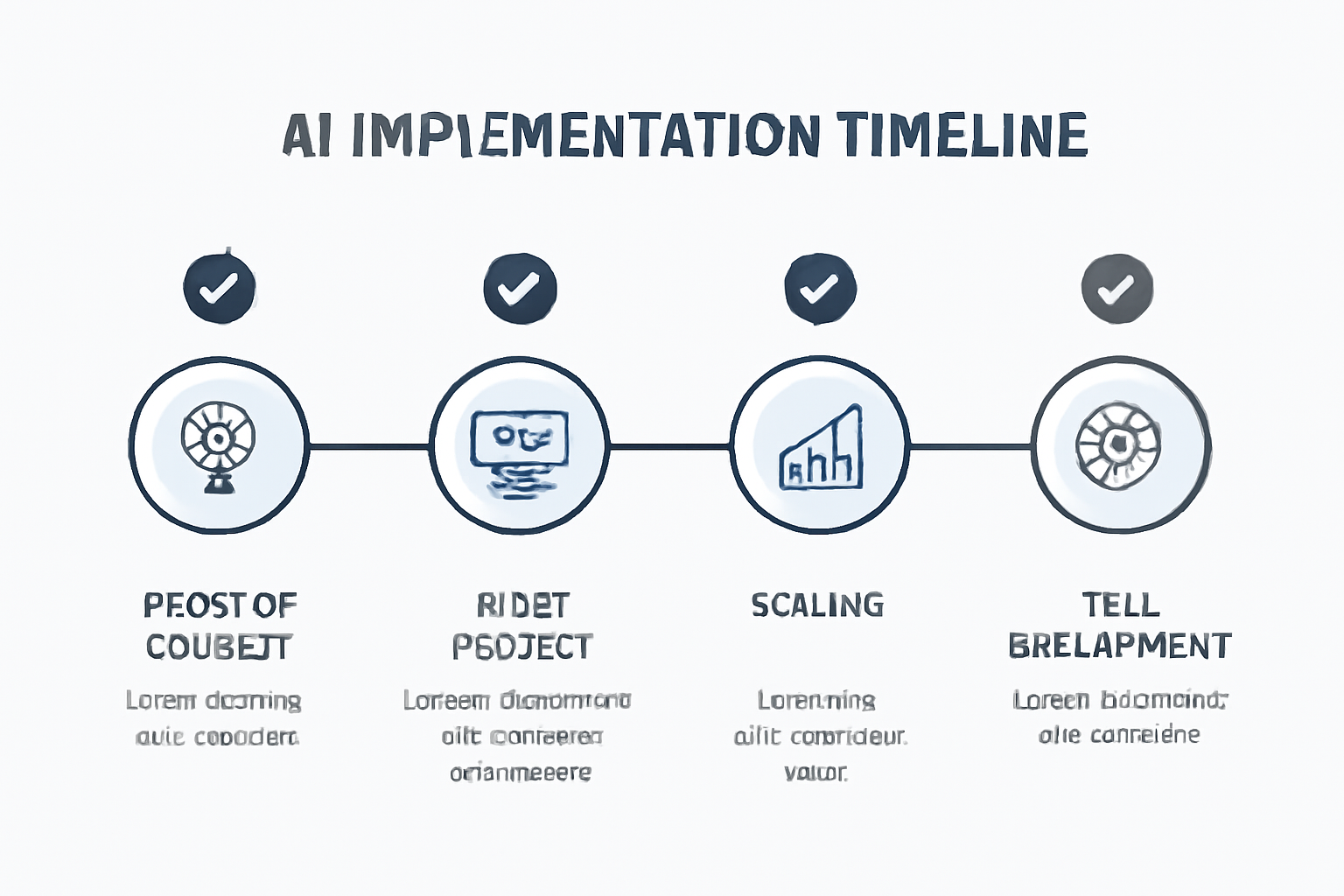
Phase 1: Discovery and Use Case Definition (4-8 weeks)
Begin by identifying specific business problems AI could address and evaluating their feasibility. Assess data availability, define success metrics, and estimate potential ROI. This phase involves stakeholder interviews, data audits, and preliminary technical assessments. Output should include prioritized use cases with business cases justifying investment.
Phase 2: Proof of Concept (8-12 weeks)
Develop a limited-scope prototype demonstrating AI feasibility for your highest-priority use case. Use a subset of data and focus on core functionality rather than production-ready features. The goal is validating technical approach and quantifying potential benefits with real data before major investment. Successful POCs provide concrete evidence for securing broader organizational support and budget.
Phase 3: Pilot Development (12-16 weeks)
Expand the POC into a pilot system deployed with a limited user group. This phase includes developing necessary integrations, implementing security controls, creating user interfaces, and establishing monitoring capabilities. Gather extensive feedback from pilot users and measure actual performance against success criteria defined in Phase 1.
Phase 4: Production Deployment (8-12 weeks)
Scale the validated pilot to full production, including all users and complete data sets. This phase emphasizes change management, comprehensive training, and establishing support processes. Implement robust monitoring and establish feedback loops for continuous improvement. Plan for gradual rollout rather than big-bang deployment to manage risk and address issues before they impact the entire organization.
Phase 5: Optimization and Scaling (Ongoing)
AI systems improve with use, so plan for continuous optimization based on performance data and user feedback. Retrain models with new data, refine algorithms based on outcomes, and expand to additional use cases. This phase never truly ends—successful AI implementation is a journey of continuous improvement rather than a one-time project.
Industry-Specific AI Applications: Real-World Use Cases
AI solutions deliver value across industries, but specific applications vary significantly based on sector-specific challenges and opportunities.
Manufacturing AI Use Cases
Manufacturers leverage AI for predictive maintenance that forecasts equipment failures before they occur, quality control systems that detect defects faster and more accurately than human inspectors, supply chain optimization that balances inventory costs against stockout risks, and production scheduling algorithms that maximize throughput while minimizing changeover time.
Healthcare AI Applications
Healthcare organizations use AI for diagnostic support that identifies patterns in medical imaging, patient risk stratification that predicts which individuals need intensive intervention, drug discovery platforms that accelerate development of new treatments, and administrative automation that reduces billing errors and streamlines claims processing.
Retail AI Solutions
Retailers implement AI for personalized product recommendations, dynamic pricing that responds to demand and competition, inventory optimization across distribution networks, customer service chatbots, and visual search tools that let customers find products using images rather than text descriptions.
Financial Services AI
Financial institutions deploy AI for fraud detection that identifies suspicious transactions in real-time, credit risk assessment that improves lending decisions, algorithmic trading that executes strategies faster than human traders, customer churn prediction, and regulatory compliance monitoring that flags potential violations.
AI Training Data: Requirements and Sourcing Strategies
AI systems are only as good as the data they learn from. Understanding data requirements and sourcing high-quality training datasets represents a critical success factor for AI implementation.
Most machine learning models require substantial training data—often thousands or millions of examples—to achieve reliable performance. The exact amount depends on problem complexity, algorithm type, and desired accuracy. Simple classification tasks might succeed with a few thousand labeled examples, while sophisticated natural language understanding systems may need millions of training instances.
Data quality matters more than quantity. Training data should be representative of real-world scenarios the AI will encounter, accurately labeled, and free from systematic biases that could lead to unfair or inaccurate predictions. Invest in data cleaning and validation processes before training models, as errors in training data propagate directly into AI system behavior.
Internal Data Sources
Most organizations possess valuable training data in existing systems—transaction records, customer interactions, sensor readings, documents, and images generated through normal operations. The challenge is identifying, extracting, and preparing this data for AI training. Establish data governance processes that make historical data accessible while protecting privacy and security.
External Data Acquisition
When internal data is insufficient, consider external sources including commercial data providers, open datasets from research institutions and governments, synthetic data generation using simulation, and data labeling services that annotate raw data according to your specifications. Evaluate external data carefully for relevance, quality, and licensing terms.
Active Learning and Data Efficiency
Modern techniques like active learning, transfer learning, and few-shot learning reduce data requirements. Active learning identifies the most informative examples for human labeling, transfer learning adapts models pre-trained on large datasets to your specific use case with less data, and few-shot learning enables models to learn from very limited examples. Explore these approaches to accelerate AI development when data is scarce.
AI Governance Framework: Ethics, Compliance, and Risk Management
As AI systems influence critical business decisions, robust governance frameworks ensure responsible deployment that manages risks and maintains stakeholder trust.
Establishing AI Ethics Principles
Define clear ethical principles guiding AI development and deployment in your organization. Common principles include fairness (ensuring AI doesn’t discriminate), transparency (making AI decision processes understandable), privacy (protecting individual data), and accountability (establishing clear responsibility for AI outcomes). Document these principles and embed them into development processes through ethics checklists and review gates.
Compliance and Regulatory Considerations
AI systems must comply with industry regulations and emerging AI-specific laws. In healthcare, AI diagnostics must meet FDA requirements. In finance, AI credit decisions must comply with fair lending laws. In Europe, GDPR grants individuals rights regarding automated decision-making. Stay informed about evolving regulations in your jurisdictions and build compliance into AI systems from the start rather than retrofitting later.
Risk Assessment and Mitigation
Systematically identify risks associated with AI systems including technical failures, biased outcomes, security vulnerabilities, and unintended consequences. Implement mitigation strategies such as diverse training data to reduce bias, robust testing protocols to catch errors, human oversight for high-stakes decisions, and clear escalation procedures when AI systems behave unexpectedly.
Establish AI audit processes that regularly review system performance, examine decisions for bias or errors, and verify compliance with policies and regulations. Document AI system behavior thoroughly to support accountability and continuous improvement.
Building AI-Ready Infrastructure: Technical Prerequisites
Successful AI implementation requires appropriate technical infrastructure including computing resources, data management capabilities, and integration architecture.
Cloud Infrastructure for AI
Cloud platforms provide scalable computing power essential for training and running AI models. Major providers offer specialized AI services including pre-trained models, training infrastructure, and deployment tools. Evaluate cloud options based on cost, performance, available AI services, data residency requirements, and integration with your existing systems. Many organizations adopt hybrid approaches, using cloud for AI development and training while deploying models on-premises for latency-sensitive or security-critical applications.
API Architecture and Integration
AI systems must integrate seamlessly with existing applications and data sources. Well-designed API architecture enables AI models to receive input data, return predictions, and trigger actions across your technology ecosystem. Implement API management platforms that handle authentication, rate limiting, versioning, and monitoring to ensure reliable AI service delivery.
Data Infrastructure and MLOps
AI development requires robust data pipelines that collect, clean, transform, and deliver training data. Production AI needs monitoring systems that track model performance and detect drift. MLOps (Machine Learning Operations) platforms automate model training, testing, deployment, and monitoring, enabling teams to iterate faster and maintain model quality over time. Invest in MLOps capabilities early to avoid technical debt as AI initiatives scale.
Measuring AI Performance: KPIs and Optimization
Deploying AI is just the beginning—continuous measurement and optimization ensure systems deliver sustained value.
Technical Performance Metrics
Track technical metrics like model accuracy, precision, recall, and latency. These metrics indicate whether AI systems perform as designed. Establish baseline measurements during development and monitor for degradation over time as data distributions shift or system conditions change.
Business Impact Metrics
More importantly, measure business outcomes AI is intended to improve. If AI optimizes marketing spend, track customer acquisition costs and conversion rates. For predictive maintenance AI, monitor equipment uptime and maintenance costs. Connect AI technical performance to business KPIs that matter to stakeholders.
Continuous Optimization
Use performance data to drive ongoing improvement. Retrain models with new data, adjust decision thresholds based on business priorities, and refine features based on what drives predictions. Establish feedback loops where system outputs are evaluated and results feed back into training data, creating a virtuous cycle of improvement.
Implement A/B testing frameworks that compare AI system variants to identify optimal configurations. Test different models, feature sets, and decision rules systematically to maximize business value.
Conclusion: Your AI Implementation Roadmap
Implementing AI solutions for business successfully requires balancing technical capabilities with strategic planning, change management, and continuous optimization. Start with clear business objectives, choose use cases with measurable impact, and build organizational capabilities progressively rather than attempting comprehensive transformation overnight.
Focus on data quality and governance from the outset, as these foundations determine AI system effectiveness. Select vendors and partners who understand your industry and demonstrate commitment to your success beyond initial implementation. Establish robust measurement frameworks that connect AI performance to business outcomes, enabling data-driven optimization and demonstrating ROI to stakeholders.
Most importantly, view AI implementation as a journey rather than a destination. Technology evolves rapidly, business needs change, and AI systems improve with experience. Organizations that build learning cultures, invest in ongoing optimization, and remain flexible in their approaches will realize the greatest long-term value from AI solutions. The competitive advantages AI offers—enhanced efficiency, deeper insights, and superior customer experiences—make the implementation journey worthwhile for businesses committed to thriving in an increasingly AI-driven economy.